

What Is Edge AI?
Edge AI is the use of artificial intelligence on or near the device where data is created. Instead of sending every photo, sound, or sensor reading to a distant cloud server for analysis, an edge device can use a trained AI model locally. That device might be a camera, smartphone, vehicle, factory machine, or nearby edge computer.
The term combines edge computing, which processes data closer to its source, with AI tasks such as recognizing patterns or making predictions. For example, a smart camera can identify a person in its field of view, while an industrial sensor can detect signs of unusual machine behavior. In both cases, the system analyzes incoming data near the equipment producing it.
Edge AI does not mean that every stage of AI happens on a small device. Training a model often requires powerful computers and large datasets, so it may take place in a cloud platform or data center. The trained model can then be optimized and deployed to edge hardware, where it performs inference by applying what it learned to new data.
How Edge AI Works
An Edge AI system starts with data from a local source, such as a microphone, camera, or temperature sensor. A model running on a connected device or gateway analyzes that input and produces a prediction or classification. Depending on the application, the device may then trigger an action, alert a person, or save a result for later review.
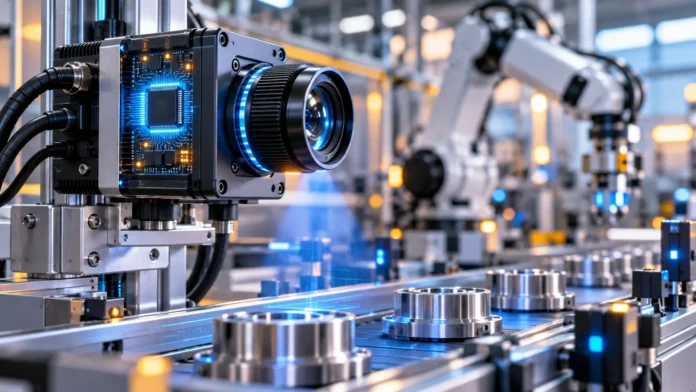
For example, a factory camera could use computer vision to check whether a product appears damaged on an assembly line. The camera or nearby industrial computer processes each image and flags potential defects. Workers can respond quickly, while the system sends only selected images or summarized results to another platform for monitoring and analysis.
The device needs suitable hardware and software to run the model reliably. A small device might use a low-power processor or neural processing unit, while a more demanding workload could run on an edge server. Developers usually test the model on its target hardware because available memory, power, heat capacity, and processing speed affect real-world performance.
Why Edge AI Is Growing
Organizations are connecting more devices to the internet, creating a growing stream of data from factories, vehicles, shops, homes, and public infrastructure. Sending every data point to a cloud platform can add cost and complexity. Edge AI offers another option: analyze useful information near where it is generated and share only what a wider system needs.
Many applications also need results quickly. A machine monitoring system may need to react to a problem while equipment is still operating, and a smart camera may need to identify an event without waiting for a remote response. Local AI processing can reduce the time spent transferring data back and forth, although actual speed depends on the hardware and network design.
Edge AI has also benefited from improvements in processors, AI accelerators, and model optimization. Devices can now perform certain AI tasks that once required much more computing power. Smaller models and specialized chips make it practical to run image recognition, speech processing, and other forms of machine learning on a wider range of edge devices.
Main Benefits of Edge AI
One benefit is lower latency, or the time between a system receiving information and responding to it. When a model runs close to the data source, it may not need to wait for a request to travel to a remote cloud and back. This can be useful for applications that need timely detection, alerts, or control.
Edge AI can also reduce how much data needs to travel over a network. A camera may analyze video locally and send a short event notification instead of continuously uploading every frame. This can ease bandwidth demands and help organizations manage storage, especially when they operate many sensors or devices across different locations.
Keeping some data on a local device may support privacy and data governance goals. A system can process sensitive audio, video, or operational information locally and send only a limited result elsewhere. This does not automatically make an application private or secure; organizations still need to control access, protect devices, and decide what data is collected and retained.
Common Edge AI Applications
Manufacturing is a prominent use case because equipment generates continuous operational data. Edge AI can help identify patterns linked to equipment wear, inspect products for visible defects, or monitor processes for unusual conditions. These tools can support predictive maintenance and quality control, while people remain responsible for interpreting important alerts and deciding how to respond.
In retail, edge devices can support inventory monitoring, store security, and checkout experiences. A system might use cameras or shelf sensors to detect that a product needs restocking, or help track activity in a specific area. Implementations should account for customer privacy, local regulations, and clear limits on what images or identifying data are collected.
Edge AI also appears in consumer devices, vehicles, healthcare equipment, and smart buildings. Smartphones can use on-device models for tasks such as image processing or voice features, while connected vehicles can analyze data from onboard sensors. In healthcare, edge processing may support specific device functions, but clinical use requires careful validation and appropriate professional oversight.
Edge AI vs. Cloud AI
Cloud AI runs models on remote servers accessed through an internet or private network connection. This approach can provide access to powerful computing resources and make it easier to manage some models centrally. It can suit tasks that involve large datasets, complex analysis, or information that needs to be combined across many locations.
Edge AI runs inference on a device or nearby computing system. This can reduce dependence on a constant connection and allow applications to respond locally. However, edge devices usually have tighter limits on compute, memory, power, and cooling, so they may not be able to run the largest or most demanding models.
Many practical systems use both approaches. An edge device can handle quick decisions and filter incoming data, while a cloud platform supports model training, fleet management, or broader analysis. This hybrid setup lets teams place each task where it fits best, instead of treating edge and cloud computing as competing choices.
The Role of 5G, Wi-Fi, and Connectivity
Edge AI can operate without a fast external connection if the model and data are available locally. Connectivity still matters when devices need to report results, receive software updates, or coordinate with other systems. A network also allows organizations to monitor many edge devices and manage them as part of a larger deployment.
The best connection depends on where devices are installed and what they need to do. Wi-Fi can suit many indoor sites, while wired networks may be preferred for fixed equipment that needs predictable connectivity. Cellular networks can help connect mobile devices or locations where installing cables is difficult. Network choice affects communication, but it does not determine whether AI processing happens at the edge.
When comparing wireless options for a connected deployment, consider coverage, device density, latency needs, reliability, and operating costs. This 5G and Wi-Fi comparison can help explain how the two technologies differ. A strong network can support an Edge AI system, but local processing still depends on the device, model, and application design.
Edge AI Hardware and Model Optimization
Edge AI hardware ranges from tiny microcontrollers to powerful industrial computers. A low-power sensor may be able to run a compact model for a narrow task, while a robotics system may need a more capable processor or graphics accelerator. The right choice depends on the input data, required response time, expected workload, and physical environment.
Models often need optimization before they can run well on limited hardware. Developers may reduce model size, use quantization to represent values with fewer bits, or select an architecture designed for efficient inference. These techniques can lower memory and power demands, but teams must check whether the optimized model still performs accurately enough for its intended use.
Power and temperature are practical concerns, especially for battery-powered or enclosed devices. A model that performs well in a short demonstration could behave differently during continuous operation or in a hot environment. Testing should include the complete device, its sensors, software, and expected workload, rather than measuring model accuracy on a developer’s computer alone.
Challenges and Risks to Consider
Limited computing resources can restrict the complexity of models deployed at the edge. If the task needs extensive reasoning or analysis across large volumes of data, a small device may not be the right place to run it. Developers need to balance accuracy, speed, memory, battery use, and cost instead of optimizing for one measure alone.
Managing security across many distributed devices can also be difficult. Every device may need secure startup, access controls, encrypted communication, software updates, and a plan for handling lost or compromised equipment. An Edge AI deployment should include ongoing maintenance and monitoring, because a device left unpatched can become a weakness in the larger system.
Data quality and model reliability matter just as much as hardware. A model can perform poorly when real-world conditions differ from its training data, such as changes in lighting, background noise, or machine behavior. Teams should test for failure cases, monitor performance after deployment, and provide a way for people to review or override consequential decisions.
How Businesses Can Adopt Edge AI
Start with a specific operational problem rather than choosing AI technology first. Look for a task where local analysis could improve response time, reduce unnecessary data transfers, or help staff identify important events. Define what better performance would mean, such as fewer missed defects or faster alerts, and compare it with the current process.
Next, check the data source, device environment, connectivity, and business constraints. Determine whether existing cameras or sensors provide usable information, whether the location has reliable power, and how much data must be stored. Also consider privacy, cybersecurity, integration with existing software, and who will be responsible for maintaining devices after deployment.
A small pilot can help reveal issues before an organization invests in a larger rollout. Test the model on the intended hardware under realistic conditions, then measure accuracy, response time, stability, and operating cost. Involve the people who will use the system, document where human review is necessary, and scale only when the results justify the added complexity.
What the Future of Edge AI May Look Like
Edge AI is likely to keep expanding as connected devices gain better processors and more efficient AI models. This may make it practical to run increasingly capable features on phones, cameras, vehicles, and industrial equipment. The pace will vary by device and application, since power, cost, reliability, and safety requirements still place limits on what can run locally.
Another direction is coordinated AI across devices, local edge servers, and cloud platforms. A device may handle immediate recognition, a nearby server may combine data from several sensors, and a cloud platform may support long-term analysis or model updates. This distributed approach can match computing resources to different tasks, provided the system is designed and secured as a whole.
Smaller models and tools for deploying them could make Edge AI easier to use beyond large technology companies. Yet wider availability also raises questions about privacy, security, accuracy, and accountability. Responsible growth will require clear testing, transparent data practices, and human oversight wherever automated decisions could affect people or critical operations.
Conclusion
Edge AI brings artificial intelligence closer to the devices and environments where data is created. By running inference locally, it can support timely responses, reduce network traffic, and limit how much raw data needs to leave a site. These advantages make it useful for applications such as industrial inspection, smart devices, and connected infrastructure.
The approach also comes with real constraints. Edge hardware has limited resources, distributed devices require ongoing security and maintenance, and AI models need careful testing under real operating conditions. Many deployments will combine edge processing with cloud services, giving each part of the system work it can handle effectively.
Edge AI is growing because organizations want intelligent systems that respond efficiently and work across connected environments. Its success depends on choosing the right task, hardware, model, and safeguards. For businesses, a focused pilot with measurable goals is a practical way to find out whether edge computing and AI solve a problem worth investing in.
FAQs
What is Edge AI in simple words?
Edge AI means running AI models on or near the device that collects the data. The device can analyze information locally instead of sending every input to a remote cloud server.
How is Edge AI different from cloud AI?
Edge AI processes data on a device or nearby computer, while cloud AI uses remote servers. Edge can support local responses; cloud services can offer more centralized computing resources.
Does Edge AI need an internet connection?
Not always. A device can run local inference offline if it has the required model and data, though internet access may be needed for updates, monitoring, or sharing results.
What devices can run Edge AI?
Edge AI can run on smartphones, cameras, sensors, vehicles, appliances, and industrial computers. The device needs enough processing power and memory for its specific AI task.
Why are companies adopting Edge AI?
Companies may use Edge AI to reduce response time, limit data transfers, and analyze information close to where it is generated. It can be useful when connectivity, bandwidth, or privacy matters.