
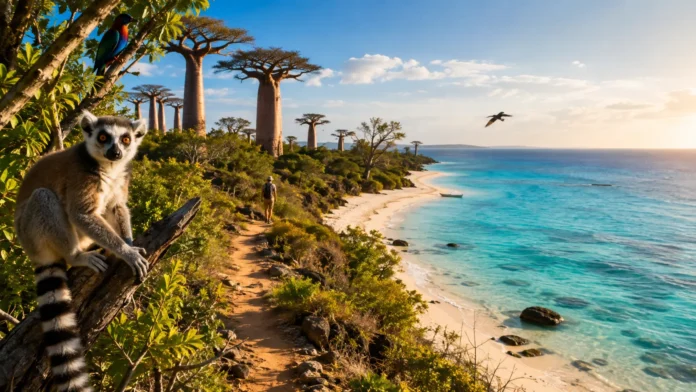

Madagascar Travel Guide: Wildlife, Beaches & Adventures
Madagascar feels less like a single tropical destination and more like several completely different worlds gathered on one enormous island. Rainforests echo with the calls of lemurs, dry western landscapes are punctuated by enormous baobab trees, sandstone formations rise above deep canyons, and white beaches meet turquoise water along the Indian Ocean. Its extraordinary biodiversity attracts wildlife lovers, while hikers, photographers, beach travelers, and adventurous road trippers can build equally rewarding journeys. Traveling here requires more patience than visiting a compact resort island because distances are large and roads can be slow. That challenge is also part of Madagascar’s appeal, encouraging travelers to explore fewer regions more deeply rather than rushing between attractions.
The best Madagascar itinerary combines major highlights with enough flexibility for weather, transportation changes, and slower travel days. Andasibe provides one of the most accessible introductions to rainforest wildlife, Ranomafana offers beautiful forest trekking, and Isalo delivers an entirely different landscape of rock formations and canyons. Morondava is the gateway to the famous Avenue of the Baobabs, while adventurous travelers can continue toward the extraordinary limestone formations of Tsingy de Bemaraha. Along the coast, Nosy Be, Île Sainte-Marie, Ifaty, and other beach destinations offer opportunities for snorkeling, diving, whale watching, and relaxation. This Madagascar travel guide covers wildlife, beaches, national parks, adventures, cultural stops, seasonal planning, transportation, and local tips for creating a memorable trip.
Where to See Madagascar’s Incredible Wildlife
Andasibe is one of the best places to begin a Madagascar wildlife trip because its rainforest region is relatively accessible from Antananarivo compared with many of the country’s more remote protected areas. The surrounding forests are particularly famous for indri, the largest living lemurs, whose powerful calls can travel through the trees and create one of Madagascar’s most memorable sounds. Guided walks may also reveal other lemurs, chameleons, frogs, birds, insects, and remarkable plant life. Early mornings are often especially rewarding because forest activity and animal calls can be more noticeable. Staying nearby for at least two nights gives you more than one opportunity for wildlife encounters and reduces pressure to see everything during a single walk.
Ranomafana National Park offers another outstanding rainforest experience farther south along one of Madagascar’s classic travel routes. Trails pass through dense vegetation, hills, streams, bamboo, and humid forest where several lemur species and other endemic animals may be encountered with experienced local guides. Walking conditions can be slippery, muddy, and surprisingly demanding, making sturdy footwear more useful than ordinary city shoes. Wildlife watching requires patience because animals move freely rather than appearing according to a visitor schedule. Spend time observing smaller creatures as well as searching for lemurs, since Madagascar’s reptiles, amphibians, insects, and birds are part of what makes its biodiversity remarkable. Two nights nearby can give you a fuller experience than racing through on a single afternoon.
Southern Madagascar provides opportunities to see species adapted to much drier environments. Ring-tailed lemurs are among the country’s most recognizable animals, while sifakas are famous for their powerful leaps through trees and unusual movement when crossing open ground. Spiny forests contain equally distinctive plants, including thorny species and unusual succulents that make the landscape look dramatically different from the eastern rainforest. Wildlife experiences in these regions should be approached through responsible reserves, parks, and reputable guides rather than roadside animal encounters. Avoid touching, feeding, or deliberately attracting wild lemurs for photographs. Observing natural behavior from an appropriate distance creates a more meaningful experience and reduces stress on the animals you traveled so far to see.
Night walks can add another dimension to a Madagascar wildlife itinerary because several fascinating animals become active after sunset. Depending on the reserve and local rules, guides may help visitors search for mouse lemurs, nocturnal chameleons, frogs, geckos, insects, and other small creatures that remain difficult to spot during daylight. A flashlight reveals details that can easily be missed during daytime walks, including tiny reptiles sleeping on leaves or reflected eyes within vegetation. Night activities should always follow the regulations of the particular protected area rather than wandering independently through forest after dark. Wear closed shoes and listen carefully to guide instructions. These walks demonstrate that Madagascar’s biodiversity extends far beyond the charismatic lemurs featured most frequently in travel photographs.
Responsible wildlife tourism matters particularly in Madagascar because many species exist only within limited habitats and face pressure from habitat loss. Choose guides, reserves, lodges, and operators that contribute to conservation and provide meaningful local employment whenever possible. Never ask guides to disturb animals, shake branches, or move wildlife simply to create a better photograph. Keep voices moderate during sightings and allow animals enough room to move naturally through their habitat. Buying locally produced goods and paying legitimate park and guide fees can also help tourism provide economic value to communities surrounding protected areas. The most rewarding wildlife experience is not simply seeing a lemur but understanding why Madagascar’s ecosystems are extraordinary and why protecting them matters.
Avenue of the Baobabs and Western Madagascar
The Avenue of the Baobabs near Morondava is one of Madagascar’s most recognizable landscapes and deserves its reputation when experienced at the right pace. Enormous baobab trees rise beside a dusty road, creating striking silhouettes that become particularly dramatic around sunrise and sunset. Although photographs often make the avenue look completely isolated, expect other visitors during popular periods, especially when evening light is attractive. Arriving earlier allows you to walk around, observe local movement through the area, and choose a position without rushing. The site is more than a photography backdrop because baobabs are deeply connected with Madagascar’s natural identity. Seeing their immense trunks in person provides a much stronger sense of scale than any photograph can communicate.
Morondava makes the practical base for visiting the Avenue of the Baobabs and exploring additional landscapes in western Madagascar. The coastal town offers hotels, restaurants, transportation services, and access to nearby villages and natural attractions. Rather than flying or driving in solely for one sunset photograph, spend enough time to experience the area beyond the avenue itself. Other baobab formations, rural landscapes, local communities, and coastal scenery can turn the stop into a broader western Madagascar experience. Morning and evening temperatures may also feel more comfortable for outdoor exploration than the middle of a hot day. An additional night provides flexibility if clouds or rain affect your original plan for photographing the baobabs.
Tsingy de Bemaraha is one of Madagascar’s great adventure destinations, featuring dramatic limestone formations that create a landscape of sharp pinnacles, crevices, caves, forests, and natural passages. Reaching the area requires significantly more effort than visiting Andasibe or Morondava, which is precisely why travelers should avoid squeezing it into a rushed itinerary. Depending on your chosen circuit, exploration may involve ladders, suspension bridges, narrow passages, uneven rock, and exposed viewpoints. Visitors uncomfortable with heights or demanding terrain should discuss suitable routes with guides before beginning. The geological scenery feels unlike almost anywhere else in Madagascar. For adventurous travelers willing to dedicate the necessary travel time, the Tsingy can become one of the defining experiences of the entire trip.
Getting between Morondava and the Tsingy region is an adventure in itself because western Madagascar’s roads can be rough and seasonal conditions significantly affect travel times. This is a journey where an experienced driver and established local operator can be far more valuable than attempting to organize every transfer independently. River crossings, road conditions, vehicle requirements, and accommodation availability can all influence an itinerary. Build buffer time around remote western travel rather than scheduling an immediate flight or international connection after returning. Travelers accustomed to measuring trips only by kilometers may be surprised by how long relatively modest distances can require. Treat transportation days as part of the experience and avoid designing a schedule that depends on everything operating perfectly.
Western Madagascar works best for travelers who appreciate landscapes, photography, and adventure as much as conventional sightseeing. A strong itinerary might combine Morondava, several baobab locations, rural scenery, and Tsingy de Bemaraha instead of treating the region as one overnight detour. Seasonal accessibility is important, particularly for remote roads, so confirm conditions close to your travel dates. Bring protection from sun and dust, and keep camera equipment sealed when driving on unpaved routes. Carrying patience is equally important because journeys can change according to weather and road conditions. When given enough time, western Madagascar delivers some of the country’s most extraordinary scenery and a sense of remoteness that is difficult to reproduce in more accessible destinations.
Best Beaches and Islands in Madagascar
Nosy Be is Madagascar’s most established island destination and works particularly well for travelers who want to finish an adventurous wildlife trip with several relaxing beach days. Located off the northwestern coast, the island is surrounded by warm tropical water and provides access to smaller islands, snorkeling areas, diving, boat trips, and beachfront accommodation. The atmosphere is far more leisure-focused than Madagascar’s national park circuits, making it an easy place to slow down after long road journeys. Travelers can choose between resort-style stays and smaller properties depending on budget and preferred atmosphere. Avoid spending every day beside the same hotel pool, because offshore excursions reveal much of what makes the Nosy Be archipelago appealing. Building several unscheduled days also creates flexibility around sea conditions.
Nosy Iranja is one of the visually striking excursions associated with the broader Nosy Be region. The destination is known for brilliant water, pale sand, and a sandbar that creates the kind of tropical scenery many travelers associate with Madagascar’s coastline. Boat conditions and tides influence the experience, so listen carefully to local operators and avoid expecting every visit to look exactly like edited photographs. Bring effective sun protection because exposed sand can intensify both heat and glare. Swimming and photography are obvious attractions, but responsible visitors should avoid leaving plastic or disturbing coastal wildlife. A well-planned island excursion provides an excellent contrast to Madagascar’s forests and dusty overland routes.
Île Sainte-Marie, also known as Nosy Boraha, offers a different island atmosphere along Madagascar’s eastern coast. Palm-lined landscapes, beaches, villages, and a slower rhythm make it attractive for travelers who prefer a less concentrated resort environment. The island is also associated with seasonal humpback whale activity, making certain months particularly appealing for travelers interested in marine wildlife. Whale-watching trips should be selected carefully, with operators that maintain respectful distances and follow appropriate observation practices. Outside whale season, Sainte-Marie still works as a relaxing destination for cycling, swimming, coastal exploration, and quiet days beside the sea. Staying several nights allows weather conditions to vary without ruining your only planned boat excursion.
The southwestern coast provides another style of beach experience around destinations such as Ifaty, Mangily, and Anakao. Here, dry landscapes meet warm coastal water, and reef environments create opportunities for snorkeling and diving in suitable conditions. The surrounding vegetation differs greatly from northern tropical islands, adding unusual spiny forest and baobab scenery to the beach experience. Travelers following an overland route toward Toliara often add several coastal nights after visiting Isalo National Park. This sequence works well because it moves naturally from highland and canyon adventures toward the sea. Rather than comparing every Madagascar beach by sand color alone, consider which coastline fits naturally into your wider itinerary and requires the least inefficient backtracking.
Beach planning in Madagascar requires the same flexibility as wildlife travel because conditions differ by coast, season, wind, and local infrastructure. Some destinations have comfortable resorts and organized excursions, while others feel far more remote and require simpler expectations. Bring reef-safe sun protection where possible, respect marine life, and avoid standing on coral while snorkeling. Ask local operators about currents and sea conditions before swimming somewhere unfamiliar. Travelers should also avoid assuming an empty beach is automatically safe for unsupervised swimming. Madagascar’s coastline is extraordinary precisely because it remains varied and relatively undeveloped in many places, so the best beach experience comes from combining natural beauty with realistic preparation and responsible behavior.
Best Adventures, Hikes and Outdoor Experiences
Isalo National Park is one of Madagascar’s strongest destinations for travelers who enjoy hiking through open landscapes rather than dense rainforest. Sandstone formations, rocky plateaus, canyons, grasslands, and natural pools create scenery that can feel almost cinematic under bright southern light. Guided routes vary in distance and difficulty, allowing visitors to choose between shorter walks and more substantial hiking days. Temperatures can become intense in exposed areas, so carrying sufficient water and starting early can make a major difference. Strong footwear provides better protection than sandals on rocky trails. Isalo also demonstrates Madagascar’s environmental diversity, especially when visited shortly after the humid forests of Ranomafana.
The highlands provide additional trekking opportunities for travelers interested in mountain scenery and rural landscapes. Andringitra National Park is known for dramatic peaks, valleys, rock formations, and demanding hiking possibilities that appeal to visitors wanting a more physically challenging adventure. Multi-day experiences require considerably more preparation than standard nature walks, including appropriate equipment, weather awareness, and experienced local guides. Even shorter hikes can reveal impressive views without requiring an expedition-style itinerary. Temperatures at elevation may feel surprisingly cool compared with Madagascar’s beaches, so packing only tropical clothing can be a mistake. Travelers who enjoy trekking should deliberately reserve time for the highlands instead of devoting every adventure day to wildlife searching.
Snorkeling and diving provide a completely different form of adventure around Madagascar’s islands and reef systems. Nosy Be and surrounding islands are popular starting points, while parts of the southwest also provide access to extensive marine environments. Conditions, visibility, and marine sightings vary seasonally, making local advice particularly important. Choose properly established dive operators and communicate your experience level rather than attempting advanced conditions to avoid missing an opportunity. Beginners can often find introductory options, while certified divers may seek reefs, walls, wrecks, or larger marine life depending on destination. Leaving several coastal days in your itinerary gives you alternatives if wind or sea conditions disrupt your first planned outing.
Whale watching can become a memorable seasonal experience, particularly around Madagascar’s eastern waters when humpback whales migrate through the region. Boat trips may offer opportunities to observe breaching, tail displays, or mothers with calves, although wildlife sightings can never be guaranteed. Responsible observation should prioritize the animals rather than repeatedly chasing them for closer photographs. Select operators that communicate clearly about safe approach practices and realistic expectations. Even when whales remain farther away, seeing them in Madagascar’s coastal environment can be an extraordinary experience. Plan additional activities around the destination so the trip remains worthwhile if weather postpones your scheduled departure or marine conditions prevent boats from operating.
Adventure in Madagascar also includes the journeys between destinations, which can require considerably more flexibility than an ordinary city-based holiday. River crossings, unpaved roads, domestic flights, boat transfers, and long overland drives can all become memorable parts of the trip. This does not mean travelers should deliberately seek unsafe conditions, but it does mean accepting that rigid schedules often work poorly. Build rest days between demanding hiking or road segments and avoid planning physically intense activities immediately after extremely long transfers. Keep essential medication, valuables, and a change of clothes accessible rather than buried deeply inside luggage. Madagascar rewards adaptable travelers who treat unexpected changes as part of exploration while still making sensible decisions about safety.
Antananarivo, the Highlands and Malagasy Culture
Antananarivo, commonly called Tana, is the main arrival point for many international travelers and provides an introduction to Madagascar beyond wildlife and beaches. The capital spreads across hills filled with dense neighborhoods, historic buildings, markets, churches, traffic, and viewpoints. Many visitors are tempted to leave immediately for national parks, but spending some time here can add cultural context to the landscapes encountered later. Explore with realistic expectations because Tana is a busy working city rather than a polished resort destination. An experienced local guide can make historical areas easier to understand while also simplifying transportation. Daylight exploration is generally preferable to wandering unfamiliar neighborhoods late at night.
Madagascar’s central highlands reveal terraced rice fields, traditional houses, agricultural landscapes, towns, and cooler temperatures that contrast sharply with coastal regions. Overland travelers following the RN7 corridor encounter changing scenery as they move south from Antananarivo toward Antsirabe, Fianarantsoa, Ranomafana, Isalo, and eventually the southwest. This route is popular because it links several major experiences without requiring repeated returns to the capital. However, road journeys can be long, so schedule overnight stops instead of viewing every intermediate town as an inconvenience. The highlands provide an opportunity to see ordinary rural life and agricultural landscapes between national parks. Some of the most memorable Madagascar views appear through the vehicle window rather than at named attractions.
Antsirabe is often included in highland itineraries and offers a convenient pause between Antananarivo and destinations farther south. Its broad streets, markets, workshops, thermal history, and surrounding countryside provide travelers with experiences different from forest trekking. Local artisans produce a variety of handicrafts and decorative items, creating opportunities to buy souvenirs directly from workshops when visits are arranged responsibly. Take time to understand how products are made instead of viewing each workshop purely as a shopping stop. The city can also serve as a base for exploring nearby rural landscapes. One relaxed night helps break up lengthy overland journeys and prevents a Madagascar itinerary from becoming an exhausting sequence of vehicle transfers.
Food is another important way to engage with Malagasy culture. Rice plays a central role in many meals, accompanied by vegetables, meat, fish, or regional preparations depending on location and household traditions. Coastal areas naturally emphasize seafood more heavily, while highland cuisine reflects different agricultural products and cooler conditions. Travelers should try local dishes while using ordinary food-safety judgment regarding water, raw ingredients, and street food. Ask guides or accommodation staff for restaurants that serve Malagasy cooking rather than eating only international hotel meals. Meals can also reveal cultural diversity because Madagascar contains numerous regional communities with different traditions, languages, ingredients, and customs.
Cultural respect should remain part of every Madagascar trip, particularly when visiting rural communities or sacred places. Malagasy traditions include local customs and taboos often described as fady, which may vary considerably from one region or community to another. What seems harmless to a visitor may carry cultural meaning locally, making guide instructions important. Ask permission before closely photographing people, ceremonies, homes, or children instead of assuming public visibility equals consent. Dress and behave respectfully around tombs, churches, villages, and other culturally significant places. Approaching Madagascar as a living country rather than a wildlife theme park creates deeper interactions and produces a more balanced understanding of the people whose communities surround the landscapes travelers come to experience.
Best Time to Visit Madagascar and How Long to Stay
The drier months are generally the easiest period for a broad Madagascar itinerary because roads and national park access tend to be more predictable than during the wettest part of the year. Conditions vary significantly across such a large island, however, so one universal weather description cannot accurately represent every region. Eastern rainforests receive more moisture than the dry southwest, while highland temperatures may become cool enough to require warm layers. Travelers combining several regions should therefore pack for multiple environments rather than imagining consistently hot tropical weather. Dry-season popularity can also increase demand at famous parks and lodges. Reserve important accommodations and specialized guides ahead when your travel dates are inflexible.
The wetter season can transform landscapes with greener vegetation but may also make transportation significantly more difficult. Heavy rain can affect secondary roads, remote parks, river crossings, and overland schedules, particularly in regions already dependent on rough tracks. Some destinations become impractical or inaccessible during the most challenging periods. This does not mean every part of Madagascar shuts down, but itinerary design requires greater attention to local conditions. Travelers visiting during wetter months should focus on routes known to remain manageable and maintain extra flexibility around transportation. Confirm access shortly before departure rather than assuming information from a previous year’s travel report remains accurate.
Wildlife interests can also influence the best time to visit Madagascar. Different months can bring changes in lemur behavior, young animals, reptile activity, flowering plants, birdlife, and marine wildlife. Humpback whale watching is seasonal, while certain reptiles and amphibians may be easier to encounter during warmer or wetter conditions. Photographers may prefer greener landscapes even when rain is more likely, whereas hikers often value drier trails and more predictable road access. There is therefore no single perfect month for every traveler. Decide which two or three experiences matter most and select your travel period around those priorities rather than trying to maximize every possible wildlife and weather condition simultaneously.
A one-week Madagascar trip is possible, but it requires a tightly focused itinerary around one or two regions. Travelers with limited time might combine Antananarivo and Andasibe with several beach days, or fly toward a single coastal region rather than attempting the entire RN7 route. Around two weeks allows a far more satisfying combination of rainforest, highlands, national parks, and coast. Three weeks provides room for western Madagascar, additional beach time, or more remote adventures without turning every second day into transportation. Madagascar is larger and slower to navigate than many first-time visitors expect. Adding destinations does not necessarily improve the trip if you spend most daylight hours inside vehicles.
Build at least one flexible day into a longer Madagascar itinerary, especially when domestic flights, remote roads, or boat transfers are involved. This buffer can absorb weather delays without forcing you to cancel a major park visit or risk missing an international flight. Spend your final night before departure relatively close to the airport whenever practical rather than relying on a long same-day overland transfer. Rest days are also useful after multi-day hikes or demanding road journeys. A carefully paced itinerary may contain fewer destination names but provide considerably more meaningful experiences. Madagascar is a country where slowing the schedule is often the single best planning decision you can make.
Getting Around Madagascar and Essential Local Tips
Transportation is one of the most important elements of Madagascar trip planning because travel times can be considerably longer than distances suggest. Paved highways connect some major destinations, but road quality varies and secondary roads can become extremely rough. Hiring a vehicle with an experienced local driver is often more practical than independent driving for visitors unfamiliar with local conditions. Drivers understand road surfaces, fuel stops, realistic journey times, and regional routes in ways that navigation applications cannot always capture. For particularly remote areas, four-wheel-drive vehicles may be necessary. Avoid creating an itinerary based entirely on estimated map distances because actual driving conditions should determine how much ground you attempt to cover.
Domestic flights can save substantial time when connecting distant regions, particularly when combining northern islands, western Madagascar, or the far south with Antananarivo. However, schedules can change, so travelers should avoid building extremely tight international connections around domestic arrivals. Confirm flights close to departure and maintain contact with your accommodation or local operator when schedules are important. Flying one direction and traveling overland through another region can create a balanced itinerary that reduces repetitive road journeys. Keep essential items in carry-on luggage whenever possible. A missed suitcase is inconvenient anywhere, but it becomes substantially harder to resolve when you immediately leave for a remote national park.
Avoid unnecessary nighttime road travel, particularly on long intercity routes or through remote regions. Road hazards become more difficult to see after dark, while lighting and emergency support may be limited in many areas. Plan departure times so major journeys finish during daylight whenever possible. For western and southern adventures, working with recognized local operators and experienced drivers adds useful logistical knowledge. Keep valuables discreet in towns and avoid displaying expensive electronics or large amounts of cash unnecessarily. Ordinary situational awareness matters in Madagascar just as it does in many destinations where economic differences between visitors and local residents are significant.
Pack according to the itinerary rather than the tropical image of Madagascar. Lightweight clothing is useful in hot coastal regions, but highlands and early mornings can be cool enough for a fleece or light jacket. Bring sturdy walking shoes, rain protection, a hat, insect protection, sunscreen, and a reusable water bottle. A small headlamp is valuable around lodges, camps, and locations with limited lighting. Power outages or unreliable electricity can occur, making a charged power bank especially useful. Keep personal medication and basic travel essentials with you rather than assuming every small town will stock familiar brands. Thoughtful packing makes remote travel considerably more comfortable without requiring an enormous suitcase.
The most useful local tip is to travel with patience and avoid comparing Madagascar’s infrastructure with destinations designed around fast mass tourism. Service may operate at a different pace, road journeys can take longer than expected, and plans sometimes change with little notice. Instead of allowing every delay to become a source of frustration, build enough flexibility that small disruptions do not destroy the itinerary. Learn a few basic Malagasy or French greetings where practical and interact respectfully with guides, drivers, hotel staff, and community members. Support locally owned businesses when they provide suitable services. Travelers who arrive curious, adaptable, and prepared usually experience a much richer side of Madagascar than those attempting to force the country into an inflexible schedule.
Conclusion
Madagascar is one of the world’s most distinctive adventure destinations because its wildlife, landscapes, beaches, and cultures cannot be reduced to one type of trip. Eastern rainforests provide opportunities to hear indri and search for chameleons, while the south introduces dry forests, sandstone canyons, and dramatically different ecosystems. Western Madagascar offers baobabs and the extraordinary Tsingy landscapes, while tropical islands provide a place to slow down after challenging overland journeys. Few countries allow travelers to experience such extreme environmental variety within one national border. That diversity makes Madagascar especially rewarding for people who want their holiday to feel exploratory rather than predictable.
Wildlife is understandably the main reason many people choose Madagascar, and seeing lemurs in natural forest can become a lifelong travel memory. However, focusing only on famous animals means overlooking the reptiles, frogs, birds, plants, insects, landscapes, and communities that make those ecosystems possible. Guided visits can reveal details that inexperienced visitors would walk past without noticing. Responsible wildlife encounters also support the idea that healthy forests have economic as well as ecological value. Give each park enough time rather than attempting to collect as many lemur species as possible. Slow observation often produces more meaningful encounters than rushing toward the next photographed animal.
Madagascar’s beaches add another dimension and can transform an active wildlife itinerary into a balanced holiday. Nosy Be and nearby islands suit travelers wanting tropical water and organized marine activities, while Sainte-Marie offers a slower eastern island experience and seasonal whale watching. The southwest provides coastal landscapes that pair naturally with Isalo and overland RN7 adventures. Instead of adding a beach destination simply because every tropical trip supposedly needs one, choose the coastline that connects efficiently with your route. Several relaxing days beside the sea can also provide valuable recovery after long drives and demanding hikes.
Planning remains essential because Madagascar is not a destination where travelers should assume quick transfers between every famous attraction. Roads, weather, seasonal access, domestic transportation, and large distances make realistic scheduling extremely important. Two weeks provides a much stronger foundation for a varied first trip than attempting to cross the country in several days. Use experienced local drivers and guides where they add safety, logistical knowledge, and cultural understanding. Build extra time around remote journeys and important flight connections. A carefully paced Madagascar itinerary can feel adventurous without becoming unnecessarily stressful.
Ultimately, the best Madagascar trip balances ambition with patience. See lemurs in the rainforest, stand beneath ancient-looking baobabs, hike through sandstone canyons, swim in warm coastal water, and spend time learning about the communities connecting these landscapes. Do not worry about seeing the entire island during one visit because its scale and diversity make that unrealistic for most travelers. Choose several regions that match your strongest interests and experience them properly. Madagascar rewards people willing to accept slower journeys and occasional unpredictability in exchange for extraordinary nature and genuine adventure. For wildlife enthusiasts, photographers, hikers, and travelers seeking somewhere genuinely different, few destinations offer a comparable experience.
Frequently Asked Questions About Madagascar
How many days do you need in Madagascar?
Around two weeks is a good starting point for a first trip combining wildlife, landscapes, and some beach time. Travelers with only one week should concentrate on one or two regions, while three weeks allows western or more remote destinations to be included without excessive rushing.
What is Madagascar most famous for?
Madagascar is particularly famous for its endemic wildlife, especially lemurs, as well as baobab trees, unusual reptiles, rainforests, Tsingy limestone formations, and beautiful Indian Ocean beaches. Its isolation has produced ecosystems and species that visitors cannot experience naturally anywhere else.
What are the best places to visit in Madagascar?
Popular first-trip highlights include Andasibe, Ranomafana, Isalo, Morondava and the Avenue of the Baobabs, Tsingy de Bemaraha, Nosy Be, and Île Sainte-Marie. The best combination depends on your available time, season, interest in wildlife, and tolerance for long overland journeys.
What is the best time to visit Madagascar?
The generally drier part of the year is often easiest for national parks, hiking, and overland travel, although weather differs considerably by region. Your ideal timing may also depend on whale watching, wildlife interests, beach plans, and which remote roads you need to use.
Is Madagascar good for adventure travel?
Yes, Madagascar is an excellent adventure destination for rainforest trekking, wildlife watching, hiking, diving, snorkeling, whale watching, rugged road trips, and exploring remote landscapes. Travelers should plan conservatively, use reputable local guides or drivers where appropriate, and leave extra time for transportation changes.