
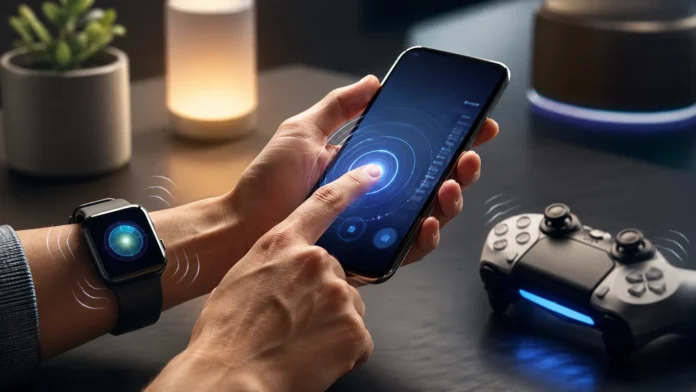

What Does Haptics Mean? Simple Guide & Examples
The word haptics may sound technical, but the basic idea is simple: haptics is technology that communicates information through the sense of touch. If your phone vibrates when you receive a message, a game controller shakes after an explosion, or a smartwatch taps your wrist when you need to turn while navigating, you are experiencing haptic feedback. These physical sensations can make digital devices feel more responsive and interactive because users receive information without relying only on what they see or hear. Haptic technology is now used in smartphones, gaming, cars, wearable devices, virtual reality, medical equipment, industrial systems, and accessibility tools.
Understanding what haptics means is becoming increasingly useful as touch-based interfaces become more common. Modern haptic systems can create simple vibrations, short taps, resistance, pressure, or more complex sensations designed to imitate interaction with physical objects. Some technologies use motors inside consumer devices, while advanced systems rely on actuators, ultrasonic waves, electrical stimulation, or force-feedback mechanisms. The goal is usually the same: make digital interaction feel more physical, intuitive, or informative. This guide explains the haptics meaning, how haptic feedback works, its main types, common examples, benefits, limitations, and the ways it is changing consumer and professional technology.
What Does Haptics Mean?
Haptics refers to technology that creates or uses the sense of touch to communicate information to a person. The word comes from a concept related to touching or perceiving through touch, which is why haptic technology is often described as tactile technology. Instead of presenting information only through a screen or speaker, a haptic system produces a physical sensation that users can feel. That sensation might be a vibration, tap, pulse, pressure, movement, or resistance. The feedback can confirm that an action occurred, warn the user about something, imitate a physical interaction, or make a digital experience feel more realistic.
A simple example is the brief vibration you feel when typing on a smartphone keyboard with haptic feedback enabled. The screen itself does not physically move like a mechanical key, but the phone creates a small vibration when your finger touches a virtual button. This tactile response helps imitate the feeling of pressing something physical and can make touchscreen typing feel more responsive. The same principle appears in navigation apps, wearable devices, game controllers, and car controls. The sensation communicates something through touch rather than requiring the user to constantly watch a display.
Haptics is different from ordinary vibration when the physical sensation is intentionally designed to communicate specific information or improve interaction. A device can vibrate simply because a motor is operating, but a haptic system controls the sensation according to an event or command. For example, a smartwatch might create one vibration pattern for an incoming message and another pattern for a navigation instruction. A gaming controller can produce different feedback depending on whether a player is driving over smooth pavement, gravel, or rough terrain. These differences allow touch to function as another communication channel between the device and the user.
The term haptic feedback is often used interchangeably with haptics in everyday technology discussions, although haptics is the broader category. Haptic feedback specifically describes the physical response a device provides after the user takes an action or when the system needs to communicate something. Pressing a virtual button and feeling a short pulse is haptic feedback. Feeling resistance in a racing wheel while turning is also haptic feedback, although it involves force rather than simple vibration. The type of sensation depends on the hardware and the experience the designer wants to create.
Haptics therefore allows technology to communicate through touch in much the same way that screens communicate visually and speakers communicate through sound. It can provide confirmation, direction, warning, realism, or accessibility without requiring additional visual attention. As devices become more compact and interfaces become increasingly digital, touch feedback can make controls easier to understand and more natural to use. The simplest haptics meaning is technology that creates meaningful physical sensations so people can feel information rather than only seeing or hearing it.
How Does Haptic Technology Work?
Haptic technology works by converting a digital signal into a physical sensation that the user can feel. A processor or software application first identifies an event that should trigger feedback, such as a button press, notification, game action, navigation instruction, or warning. The device then sends a command to a physical component called an actuator. The actuator creates movement, vibration, pressure, resistance, or another tactile effect. The exact sensation depends on the type of actuator, its strength, timing, frequency, and how the device is positioned against the user’s body.
Basic haptic systems often use small vibration motors. Older phones commonly used eccentric rotating mass motors, which create vibration by spinning an unevenly weighted component. More advanced devices frequently use linear resonant actuators or similar mechanisms that can produce sharper and more precisely controlled movements. These improved actuators allow designers to create short taps, double pulses, soft clicks, and other distinct sensations rather than one continuous buzz. The increased precision is why modern smartphones can make virtual buttons feel surprisingly responsive even though there is no physical mechanical switch beneath the display.
Software is equally important because the physical hardware must know when and how to activate. Developers can design haptic feedback patterns to correspond with different user actions and events. A soft tap might confirm a successful action, while a stronger vibration could signal an error or urgent notification. Gaming software can change feedback intensity according to what is happening on screen, while navigation applications can create distinct patterns for left and right turns. Carefully designed patterns help users learn what each sensation means without needing to look at the screen.
More advanced systems go beyond vibration and create force feedback. A racing wheel, for example, can push against the player’s hands when a virtual car turns sharply or loses traction. A medical simulator may create resistance when a trainee interacts with a virtual organ or surgical instrument. Robotic controls can return physical forces to an operator, helping the person understand contact with objects located far away. These systems usually rely on motors or mechanical mechanisms capable of producing controlled forces rather than simple vibration. Force feedback can therefore provide information about direction, resistance, weight, and surface interaction.
Emerging haptic technologies use methods such as ultrasound, electrical stimulation, air pressure, and wearable actuators to create sensations without relying on traditional vibration motors. Ultrasonic haptics can create the feeling of touch in mid-air by focusing sound waves onto a person’s hand. Wearable systems may apply pressure or vibration across several areas of the body to simulate contact in virtual environments. Although these technologies are more complex, the fundamental idea remains unchanged. A digital system detects an event, translates it into a tactile signal, and produces a physical sensation that the user can interpret through touch.
Main Types of Haptic Feedback
Vibrotactile feedback is the most common type of haptic technology in consumer electronics. It uses vibration to create sensations that communicate information or confirm user actions. Smartphones, smartwatches, game controllers, and many other portable devices use this method because vibration motors are relatively compact and energy-efficient. The vibration can vary in duration, intensity, and rhythm to create different effects. A short pulse may confirm that a button was pressed, while a repeating vibration can signal an alarm. Because most people are already familiar with vibration alerts, vibrotactile feedback is easy to understand and widely used.
Force feedback produces physical resistance or movement rather than relying only on vibration. This technology is particularly common in gaming accessories, robotics, medical simulators, and professional control systems. A gaming steering wheel might resist turning when a virtual vehicle travels at high speed, while a joystick may push back when a player encounters resistance inside a simulation. Force-feedback systems can create a stronger sense of physical interaction because they influence the movement of the user’s hands. These devices often require larger motors and more complex mechanical components than simple vibration-based systems.
Tactile surface feedback attempts to change how a surface feels when a person touches or moves across it. Some technologies use ultrasonic vibration or electrostatic forces to create the impression of texture on an otherwise smooth display. In theory, a touchscreen could feel different when a user moves a finger across a virtual button, piece of fabric, or textured object. Research and commercial development in this area aim to make flat interfaces feel more physical. Although surface haptics is less common than smartphone vibration today, it could eventually make touchscreens more expressive and reduce dependence on purely visual interfaces.
Wearable haptics places feedback directly on the body through devices such as gloves, vests, wristbands, shoes, or other accessories. A virtual-reality glove may apply pressure to fingers when a person touches a digital object, while a navigation wristband might create directional taps that guide someone without requiring them to look at a map. Haptic vests used in gaming can provide sensations across the chest or back when events occur in a virtual environment. These systems can increase immersion by spreading tactile feedback across larger areas instead of limiting it to a handheld controller.
Another category is kinesthetic haptics, which involves sensations related to movement, force, position, and resistance in muscles and joints. Instead of only stimulating the skin, kinesthetic systems affect how the body experiences motion. Advanced robotic interfaces and rehabilitation systems may use this approach to help users feel how much force they are applying or where a virtual object is located. Kinesthetic feedback can create a deeper sense of physical presence because it involves the body’s movement system rather than only surface touch. It is particularly valuable in professional training, teleoperation, simulation, and advanced virtual-reality applications.
Common Examples of Haptics in Everyday Life
Smartphones provide some of the easiest haptic examples to recognize. When you type on a virtual keyboard and feel a subtle click, the phone is using haptic feedback to confirm each touch. Haptics may also appear when unlocking the device, moving a slider, switching a setting, holding an app icon, or receiving a notification. Some phones use highly precise actuators that can create different tactile patterns for different interactions. These sensations may seem small, but they help make software controls feel more responsive and reduce uncertainty about whether the device registered an action.
Smartwatches and fitness trackers use haptics particularly effectively because they remain in direct contact with the body. A watch can tap the wrist when a message arrives, an alarm activates, or a navigation instruction approaches. Different vibration patterns can communicate different events, allowing users to understand information without immediately looking at the screen. Fitness devices may also use haptic cues during workouts, breathing exercises, or activity reminders. Because watches have limited display space, touch feedback provides an additional communication method without adding more visual clutter to the interface.
Gaming is another major example of haptic technology in action. Modern controllers can vibrate when a character is hit, a weapon fires, a vehicle crashes, or an explosion occurs nearby. More advanced controllers can vary resistance in triggers and create detailed vibration effects based on the environment. Racing wheels use force feedback to imitate steering resistance, road surfaces, and loss of traction. These sensations provide useful gameplay information while making virtual environments feel more physical. Haptics can therefore support both entertainment and performance by allowing players to feel events that are happening inside the game.
Cars increasingly rely on tactile feedback as dashboards become more digital. Steering wheels and seats can vibrate to warn drivers about lane departure, collision risks, or other conditions. Some touchscreen systems provide haptic confirmation when virtual controls are pressed, helping drivers know that the system registered the input without requiring prolonged visual attention. Advanced automotive interfaces may eventually use more sophisticated tactile surfaces and directional feedback. Haptics can be particularly valuable in vehicles because visual overload can become a safety concern when drivers must constantly look away from the road to confirm digital actions.
Everyday haptics also appear in laptops, trackpads, accessibility devices, payment terminals, medical equipment, and household electronics. Some laptop trackpads imitate a mechanical click even though the surface moves very little or not at all. Payment terminals may vibrate when a transaction is accepted, while accessibility products can use tactile patterns to communicate navigation or alerts. Medical systems may provide feedback to surgeons or trainees operating robotic equipment. These diverse examples show that haptics is not one specific product or feature. It is a flexible method of communicating information through physical sensation.
Haptics in Smartphones and Touchscreens
Smartphones rely heavily on touchscreens, but a flat glass surface provides very little natural physical feedback. Traditional keyboards contain keys that move when pressed, allowing users to feel whether an input occurred. Touchscreen buttons do not provide the same mechanical response, which can make interactions feel less certain. Phone haptics solve part of this problem by producing a small vibration when the user performs an action. The feedback creates an artificial sense of physical response even though the screen itself remains almost completely flat. This can make digital controls feel more familiar and precise.
Modern smartphone haptics are far more sophisticated than the strong buzzing vibrations found in older mobile phones. Improved actuators can produce short, precise pulses that feel more like taps or clicks than continuous vibration. Manufacturers can tune the timing and intensity so different actions create distinct sensations. Typing may produce a light response, while confirming an important action might create a stronger one. This level of control helps interface designers create a tactile language that complements visual animation and sound. When done well, users may barely notice the haptics consciously even though the device feels more responsive.
Haptic feedback can also improve touchscreen accuracy by confirming that an intended input was registered. If a user presses a virtual control and feels an immediate tactile response, there is less need to visually check whether the action worked. This is particularly useful for small interface elements, virtual keyboards, accessibility controls, and situations where the user is moving. However, haptic feedback should not be used excessively because constant unnecessary vibration can become distracting. Designers need to decide which interactions genuinely benefit from physical confirmation and which should remain silent.
Users can usually customize haptic settings on smartphones. Depending on the operating system and device, settings may allow people to enable or disable vibration for keyboard input, system controls, calls, notifications, and accessibility functions. Some devices also allow the intensity of haptic responses to be changed. Users who prefer stronger feedback can increase it, while others may reduce or disable vibrations to save battery or avoid distraction. Personal preference matters because tactile sensitivity varies between individuals. A feedback pattern that feels subtle to one person may feel too strong to another.
Future touchscreen devices may provide far more advanced sensations than today’s vibration-based phones. Researchers and manufacturers have explored surfaces that can create friction, texture, movement, or localized tactile effects. A digital keyboard could eventually feel as though individual keys have edges, while shopping applications might simulate differences between materials. These possibilities could make touchscreen interfaces easier to use without constant visual attention. Although such capabilities are not yet universal, they show how touchscreen haptics may eventually transform flat displays into interfaces that communicate through both sight and touch.
Haptics in Gaming, VR and AR
Gaming has been one of the strongest drivers of consumer haptic development because physical feedback can dramatically increase immersion. Basic game controllers have used vibration for decades, but modern systems can produce much more detailed sensations. Instead of simply shaking the controller whenever something dramatic happens, developers can create effects that imitate specific environments or actions. Walking over wood might feel different from running over gravel, while firing different virtual weapons may produce distinct trigger resistance. These sensations give players another way to understand what is happening without relying entirely on sound and graphics.
Force feedback gaming devices go further by physically resisting the player’s movement. Racing wheels can become harder to turn at high speeds, jerk when tires lose grip, or transmit small vibrations from simulated road surfaces. Flight controls may create resistance based on aerodynamic conditions inside a simulator. These effects can improve both entertainment and training because they reproduce some of the physical forces experienced in real-world vehicles. Competitive players and simulation enthusiasts may also use haptic cues as performance information, helping them react to events before they fully process them visually.
Virtual reality creates even greater opportunities because one of VR’s main challenges is the lack of physical sensation. A player may see a virtual object and reach toward it, but without haptic feedback their hand passes through empty air. VR haptics attempts to reduce this disconnect using controllers, gloves, vests, and other wearable devices. A glove might create pressure on the fingers when the user grasps a virtual object, while a vest could produce localized vibration when something touches the virtual body. The goal is to make digital environments feel more convincing by adding physical sensations to visual immersion.
Augmented reality can benefit from similar technologies. AR places digital content on top of the user’s real-world surroundings, and haptics can help users interact with virtual information as though it occupied physical space. Engineers working with AR maintenance systems might receive tactile confirmation when selecting a virtual component, while training simulations could use haptic gloves to guide hand movements. Combining visual overlays with touch feedback may be particularly useful in industrial work, education, design, and remote collaboration. The user can receive information without constantly shifting attention between a physical task and a separate display.
The biggest challenge for immersive haptics is creating realistic sensations without making hardware uncomfortable, expensive, or complicated. Human touch includes temperature, pressure, texture, weight, movement, vibration, and pain, which are difficult to reproduce simultaneously. A wearable system may imitate pressure well but fail to recreate weight or surface temperature. Even so, improvements in actuators, materials, sensors, and software continue to make immersive haptic technology more convincing. As VR and AR applications expand beyond gaming, haptics may become increasingly important for professional training, remote work, healthcare, engineering, and education.
Benefits of Haptic Technology
One of the biggest benefits of haptics is improved feedback. Digital interfaces sometimes leave users uncertain about whether an action was registered, particularly when there is no physical movement. A short vibration or tap can immediately confirm that a button was pressed, a message was sent, or a setting changed. This reduces reliance on visual confirmation and can make interactions feel more responsive. In devices where users perform many small actions throughout the day, even subtle tactile feedback can improve the overall experience. The result is an interface that feels less disconnected from the physical world.
Haptics can also reduce visual attention requirements. If a smartwatch can guide a user through different vibration patterns, the person may not need to repeatedly look at the screen. A driver can receive a steering-wheel vibration when drifting out of a lane, while a worker wearing a haptic device may receive directional instructions without stopping to read a display. This is particularly useful in environments where visual attention is limited, busy, or safety-critical. Touch becomes another communication channel that can deliver information while the eyes remain focused elsewhere.
Accessibility is another important benefit. Tactile feedback can support people who have difficulty seeing visual indicators or hearing audio notifications. A phone can communicate incoming alerts through distinct vibration patterns, while wearable navigation tools can provide directional cues through touch. Haptic interfaces may also help people interact with digital systems using alternative input and feedback methods. Accessibility design still requires careful testing because individual needs vary significantly, but touch-based communication can complement visual and auditory information. Providing multiple feedback channels makes technology usable in a wider variety of situations.
Haptics can increase immersion and realism in gaming, training, simulation, and remote operation. A medical student using a simulator can gain more useful experience if virtual procedures include resistance that resembles physical tissue. A remote robot operator may make more precise movements when the controls provide information about contact forces. A gamer can feel road conditions rather than only seeing them. These examples show that haptics can provide more than entertainment. Physical feedback can improve understanding of how virtual or remote objects behave, which can be valuable when practicing skills or controlling equipment.
Haptic technology can also create more emotionally engaging experiences. Touch has a strong psychological connection with attention, presence, and physical interaction, so well-designed haptics can make digital products feel more polished and satisfying. A precisely timed click from a smartphone button may make the interface feel higher quality even though the feature is technically simple. However, the benefit depends on careful design. Feedback that is too strong, repetitive, delayed, or inconsistent can create annoyance rather than improvement. Effective haptic design therefore requires balancing usefulness, comfort, timing, intensity, and context.
Limitations and Challenges of Haptics
One challenge is that realistic touch is extremely difficult to reproduce. Human skin can detect subtle differences in pressure, texture, temperature, vibration, movement, and material characteristics. Consumer haptic devices typically recreate only a limited subset of these sensations. A game controller may simulate an impact through vibration, but it cannot accurately recreate the temperature, shape, weight, and texture of the object involved. Advanced haptic gloves can improve realism, yet they still cannot perfectly reproduce every sensation associated with real-world touch. This technical limitation means visual and audio systems currently offer much greater realism than most tactile interfaces.
Hardware cost is another limitation, especially for advanced haptic systems. Adding a simple vibration motor to a phone is relatively inexpensive, but force-feedback devices, robotic interfaces, wearable suits, and high-precision actuators can become costly. More complex systems also require sensors, controllers, power systems, calibration, and durable mechanical components. These requirements can make advanced haptic technology impractical for low-cost consumer products. As manufacturing improves and components become smaller, prices may fall, but high-quality tactile simulation still generally requires more specialized hardware than ordinary visual or audio output.
Power consumption can also be an issue in portable devices. Creating physical movement requires energy, and repeated vibration can reduce battery life when used excessively. Smartphone and smartwatch manufacturers therefore need to balance tactile quality with power efficiency. Stronger motors may produce more noticeable feedback but consume more energy and occupy additional internal space. Wearable haptic systems face similar challenges because users expect them to be lightweight and comfortable while operating for long periods. Battery technology and actuator efficiency will influence how widely more sophisticated wearable haptics can be adopted.
Poorly designed haptics can cause discomfort or annoyance. A vibration that feels useful during an important warning may become irritating if it occurs after every minor interaction. Strong feedback can also be unpleasant for users with sensory sensitivities. Delayed haptic responses are another problem because a physical sensation that arrives noticeably after the corresponding visual event can make an interface feel unnatural. Designers therefore need to consider frequency, timing, intensity, duration, and user control. Giving people the ability to customize or disable haptic feedback is an important part of making the technology comfortable for different preferences.
Standardization remains another challenge. Different devices use different motors, actuators, software frameworks, and physical designs, which means the same haptic pattern can feel very different across products. Developers designing an experience for several phones, controllers, or wearable systems may struggle to achieve consistent results. Advanced VR haptic hardware is particularly fragmented because competing products can use completely different approaches. Broader standards and better development tools could make haptic experiences easier to design consistently. Until then, hardware differences will remain an important consideration for developers creating touch-based interfaces across multiple platforms.
The Future of Haptic Technology
The future of haptics is likely to involve more realistic and localized sensations. Instead of a phone vibrating as one entire object, future devices may produce feedback only under the area being touched. A user could press a virtual keyboard and feel individual keys, edges, or textures directly beneath their fingertips. Advanced displays may use ultrasonic waves, electrostatic forces, or flexible materials to generate these effects. This could make flat touchscreens feel much more physical without requiring mechanical buttons. If these technologies become practical at scale, they may fundamentally change how users interact with phones, tablets, car dashboards, and other touch interfaces.
Wearable haptics is another area with significant potential. Lightweight gloves, sleeves, vests, wristbands, and footwear could create richer feedback for virtual reality, sports training, navigation, rehabilitation, and remote work. An engineer could feel resistance while manipulating a virtual prototype, while a trainee might practice complex physical procedures inside a simulation. Haptic wearables could also communicate directional or safety information in noisy environments where sound is unreliable. The main challenge will be making these devices comfortable, affordable, wireless, and easy to maintain while still delivering precise feedback.
Healthcare may become one of the most important professional applications. Surgeons operating robotic systems can potentially benefit from force feedback that communicates how instruments are interacting with tissue. Medical students can use simulators to practice procedures without working directly on patients. Rehabilitation systems may use haptic guidance to help people relearn movement after injuries. Remote healthcare could also benefit if clinicians gain more tactile information while operating robotic tools. Although medical systems require rigorous testing and regulatory oversight, the ability to recreate or transmit touch could make digital medical training and remote procedures considerably more effective.
Remote robotics and teleoperation could also become much more capable through haptics. A person controlling a robot in a hazardous environment may need to know whether the robot is touching an object gently or applying too much force. Visual feedback alone may not provide enough information for delicate tasks. By sending physical forces back to the operator’s controls, haptic telepresence can make remote manipulation more intuitive. Potential applications include manufacturing, disaster response, underwater exploration, space operations, hazardous-material handling, and remote maintenance. Combining haptics with high-quality video and AI assistance could allow people to perform increasingly complex work from safe locations.
Artificial intelligence may improve haptic systems as well. AI can help predict which tactile sensation should occur based on user behavior, virtual environments, or sensor information. A simulation could generate realistic touch patterns dynamically instead of relying entirely on manually programmed effects. Machine learning may also help calibrate feedback for individual users or adapt it according to their preferences and physical responses. As AI, robotics, spatial computing, and wearable devices advance together, future haptic technology could become far more expressive than today’s vibration motors. Touch may eventually become a standard digital communication channel alongside graphics, audio, and speech.
FAQs About Haptics
What does haptics mean?
Haptics means technology that communicates information through the sense of touch. It can create vibrations, taps, pressure, resistance, or other physical sensations.
What is haptic feedback?
Haptic feedback is the physical response a device creates after an action or event. A smartphone vibrating when you press a virtual button is a common example.
What is an example of haptics?
Examples include smartphone vibrations, smartwatch taps, game-controller feedback, vibrating car seats, and force-feedback racing wheels.
Is haptic feedback the same as vibration?
Not always. Vibration is one type of haptic feedback, but haptics can also include pressure, force, resistance, movement, and simulated texture.
What are phone haptics?
Phone haptics are tactile effects created by a smartphone to confirm actions, notifications, typing, gestures, and other interactions.
Why are haptics used in gaming?
Haptics make games more immersive by letting players physically feel impacts, movement, road surfaces, weapon effects, and other virtual events.
What is force feedback?
Force feedback is a type of haptic technology that creates physical resistance or movement. Racing wheels and advanced joysticks commonly use it.
Can haptics be used in virtual reality?
Yes. VR systems can use controllers, gloves, vests, and other devices to simulate touch and physical interaction with virtual objects.
Are haptics useful for accessibility?
Yes. Haptic signals can provide notifications, navigation guidance, and other information without relying entirely on visual or audio feedback.
What is the future of haptics?
Future haptics may include realistic virtual textures, advanced wearable feedback, medical simulation, robotic teleoperation, and more immersive VR and AR experiences.