
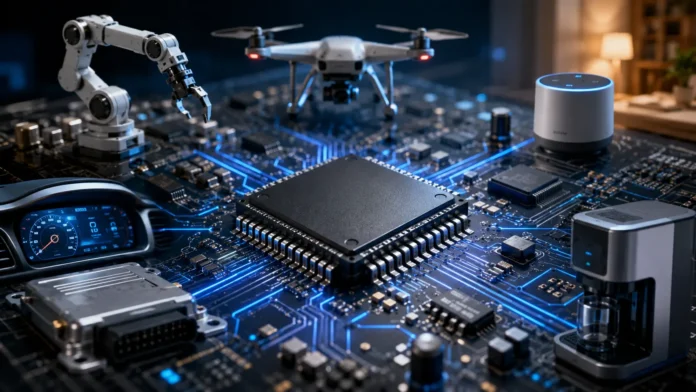

What Is a Microcontroller? Uses, Types & Examples
A microcontroller is a small integrated circuit designed to control specific functions inside electronic devices. Unlike a general-purpose computer processor that depends on many external components, a microcontroller typically combines a processor, memory, input and output interfaces, timers, and communication features on a single chip. This compact design makes microcontrollers ideal for embedded systems where cost, size, power consumption, and reliability matter. They can read information from sensors, process programmed instructions, and control motors, displays, lights, switches, or other hardware. From washing machines and automobiles to medical equipment and smart home products, microcontrollers quietly operate countless technologies people use every day.
Understanding what a microcontroller is becomes especially useful when learning about robotics, electronics, automation, IoT devices, embedded programming, and hardware product development. A microcontroller does not normally run a complete desktop operating system or perform hundreds of unrelated tasks simultaneously. Instead, it is usually programmed to perform a defined set of functions repeatedly and reliably. Different microcontroller types offer different processor architectures, memory capacities, communication interfaces, operating speeds, and power requirements. Popular families include AVR, PIC, STM32, ESP32, and numerous ARM Cortex-based devices. This guide explains how microcontrollers work, their components, major types, common uses, real-world examples, programming methods, and important factors to consider when choosing one.
What Is a Microcontroller and How Does It Work?
A microcontroller, often abbreviated as MCU, is essentially a compact computer built onto one integrated circuit. It contains a central processing unit that executes instructions, memory that stores programs and temporary information, and input/output connections that communicate with external hardware. Once power is applied, the microcontroller begins executing the program stored in its nonvolatile memory. That program may continuously read buttons, monitor sensors, perform calculations, and update connected outputs. Because all these elements are integrated into one chip, the device can operate with relatively few external components. This makes microcontrollers practical for products that need dedicated digital intelligence without the complexity of a complete computer system.
The program running on a microcontroller is commonly called firmware because it sits between hardware and conventional software. Firmware defines exactly how the device should behave when particular events occur. For example, a thermostat microcontroller might continuously measure temperature, compare the reading with a target value, and activate heating or cooling equipment when required. The process repeats automatically without the user needing to issue every command manually. Embedded firmware can range from a few hundred instructions to extremely sophisticated applications containing communication, security, diagnostics, and control logic. The capabilities depend heavily on the microcontroller’s processing power, memory, peripherals, and intended application.
Inputs allow a microcontroller to receive information about the surrounding environment or user actions. Digital inputs can detect simple states such as whether a button is pressed, while analog inputs can measure varying voltages from sensors. More advanced devices may receive information through communication interfaces connected to accelerometers, temperature sensors, displays, memory chips, or other processors. The microcontroller reads this incoming information and applies programmed logic to decide what should happen next. This ability to sense and react is what makes microcontrollers especially important in automation. They transform physical signals into decisions that electronic systems can use.
Outputs allow the microcontroller to control other components after processing information. A digital output might switch an LED on or off, while pulse-width modulation can control motor speed or light brightness. Communication outputs can send data to displays, computers, wireless modules, or other embedded devices. Some microcontrollers also contain dedicated peripherals for generating precise timing signals or controlling specialized hardware. The processor does not need to perform every low-level task manually because these built-in peripherals handle repetitive operations efficiently. This reduces processor workload and makes real-time behavior more predictable.
Microcontrollers are especially valuable because they can perform these tasks continuously with very low power consumption. Some devices can enter sleep modes that consume tiny amounts of energy and wake only when a timer, sensor, or communication event occurs. This allows battery-powered products to operate for months or even years depending on hardware design and usage patterns. Microcontrollers can also start quickly because they usually run directly from embedded firmware instead of loading a large operating system. Their combination of compact size, predictable behavior, low cost, and efficient power use explains why manufacturers place them inside such a wide variety of electronic products.
Main Components Inside a Microcontroller
The central processing unit, or CPU, is the part of a microcontroller that executes program instructions and performs calculations. It reads instructions from memory, processes data, makes logical decisions, and coordinates other parts of the chip. Microcontroller CPUs vary widely in architecture and performance, ranging from simple 8-bit designs to sophisticated 32-bit cores capable of substantial computation. Clock speed influences how quickly instructions can be processed, although architecture and peripheral design also affect actual performance. Embedded developers therefore should not judge microcontrollers solely by megahertz numbers. A slower processor with suitable hardware peripherals can sometimes perform a specific control task more efficiently than a faster general-purpose design.
Memory is another essential component because the microcontroller needs somewhere to store both firmware and temporary data. Flash memory commonly stores the program so it remains available after power is removed. RAM holds variables, buffers, and temporary information while the device is running. Some microcontrollers also include EEPROM or other nonvolatile memory for configuration values that need to survive restarts. Memory capacity varies dramatically among devices, and insufficient memory can become a major limitation during development. Choosing the right amount requires considering program size, communication buffers, sensor data, security libraries, and potential future features rather than only the first prototype.
General-purpose input/output pins, usually called GPIO, connect the microcontroller with external electronics. Developers can configure many of these pins as inputs or outputs according to application requirements. A GPIO input might detect a switch, while an output can control a transistor, relay, LED, or another digital circuit. Electrical limitations still matter because a microcontroller pin usually cannot directly power large motors or high-current loads. Driver circuits and protection components are often required between the MCU and external equipment. Understanding GPIO capabilities is fundamental to embedded development because nearly every microcontroller application interacts with the physical world through some form of input or output.
Timers and counters provide precise hardware timing that would be difficult to maintain reliably using software delays alone. They can measure time intervals, generate periodic interrupts, count incoming pulses, create PWM signals, or support communication protocols. A motor controller might use PWM to adjust speed, while an industrial sensor may use timers to sample data at exact intervals. Many microcontrollers include several timers with different capabilities so multiple operations can run independently. Hardware timing allows the CPU to perform other work while specialized peripherals maintain predictable schedules. This becomes especially important in real-time systems where even small timing errors can affect system behavior.
Communication peripherals allow microcontrollers to exchange information with other chips and systems. Common interfaces include UART, SPI, I2C, CAN, USB, and Ethernet, depending on the device family. Wireless-focused microcontrollers may also include Wi-Fi, Bluetooth, or radio hardware directly on the chip or within the same package. These interfaces make it possible to connect sensors, displays, memory, computers, vehicles, industrial networks, and IoT platforms. The number and type of communication peripherals can strongly influence which MCU is appropriate for a project. Selecting a device with the required interfaces built in often reduces external components, board complexity, and software development effort.
Types of Microcontrollers
Microcontrollers are frequently categorized according to the width of their processor architecture, such as 8-bit, 16-bit, or 32-bit devices. An 8-bit microcontroller processes smaller chunks of data at a time and is often suitable for simple control tasks with limited memory requirements. These devices can be inexpensive, power efficient, and straightforward to program. They remain useful in appliances, toys, basic sensors, simple displays, and low-cost embedded products. Their limitations become more noticeable when applications require advanced networking, large calculations, complex user interfaces, or substantial memory. Choosing an 8-bit MCU can still be an excellent engineering decision when the application genuinely does not require greater complexity.
Sixteen-bit microcontrollers occupy a middle ground between simple 8-bit devices and more powerful 32-bit architectures. They can offer improved mathematical capability, larger address spaces, and higher performance while maintaining efficient power consumption. These devices have historically appeared in automotive electronics, industrial controls, measurement equipment, motor-control systems, and other embedded applications. Some modern development has moved toward inexpensive 32-bit MCUs, but 16-bit families remain useful where existing ecosystems and specialized peripherals provide practical advantages. Processor width alone should never determine suitability. Developers need to compare real application requirements, development tools, peripherals, reliability, cost, and long-term supply.
Thirty-two-bit microcontrollers have become extremely common in modern embedded development. Many use ARM Cortex-M processor cores, while other architectures such as RISC-V are increasingly visible in MCU products. These devices can provide higher processing performance, larger memory capacity, sophisticated timers, digital signal processing, advanced communication, security features, and efficient low-power modes. They are widely used in IoT equipment, robotics, automotive systems, industrial automation, consumer electronics, medical products, and smart devices. Higher capability can simplify complex applications, but it also introduces more configuration options and software complexity. Developers should select enough performance for the product without automatically choosing the largest MCU available.
Microcontrollers can also be classified by application rather than processor width. General-purpose MCUs provide balanced features for a wide range of embedded projects, while specialized devices may focus on motor control, automotive networking, digital signal processing, wireless connectivity, or ultra-low-power operation. A motor-control MCU might contain specialized PWM and analog peripherals, while a wireless MCU could integrate Bluetooth and Wi-Fi. Automotive devices may provide CAN interfaces and reliability features designed for harsh environments. Application-focused integration can reduce the number of external chips needed. This can lower system cost and simplify circuit design when the specialized features match the product requirements.
Another distinction involves whether a microcontroller integrates wireless communication directly. Traditional MCUs usually depend on separate radio modules when wireless networking is required, while newer system-on-chip designs often combine processing and radio capabilities. Devices such as ESP32-class microcontrollers can integrate Wi-Fi and Bluetooth alongside CPU cores, memory, and peripherals. This makes them attractive for IoT devices, smart home products, connected sensors, and prototyping. Wireless integration still introduces antenna, certification, power, security, and software considerations. A convenient built-in radio reduces hardware complexity but does not eliminate the engineering work required to build a reliable connected product.
Common Uses of Microcontrollers
Consumer electronics are among the most familiar applications of microcontrollers even though users rarely see the chips themselves. Washing machines use MCUs to control cycles, water levels, motors, displays, sensors, and safety features. Microwave ovens rely on microcontrollers for timing, keypad input, displays, and power control. Televisions, remote controls, coffee makers, air conditioners, electric toothbrushes, and countless other devices contain embedded controllers. In each case, the microcontroller performs a specific set of functions repeatedly. Manufacturers benefit because one programmable chip can replace larger collections of fixed-function electronic circuitry while allowing product behavior to be changed through firmware.
Automobiles contain many microcontrollers responsible for different functions throughout the vehicle. Individual controllers can help manage lighting, windows, seats, climate systems, airbags, dashboard electronics, sensors, battery systems, motor control, and communication between vehicle subsystems. Modern vehicles may contain many interconnected electronic control units, depending on design and complexity. Automotive microcontrollers often require strong reliability, temperature tolerance, real-time behavior, and specialized communication interfaces such as CAN. Safety-critical applications also require significantly stricter engineering than hobby projects. The automotive industry demonstrates how microcontrollers can coordinate complex physical systems while remaining hidden from the driver.
Industrial automation depends heavily on embedded controllers for monitoring machines and controlling physical processes. Microcontrollers may read temperature, pressure, position, vibration, flow, or current sensors and respond by controlling motors, valves, relays, or actuators. They can also communicate with industrial networks or supervisory systems for remote monitoring. Some applications require deterministic response times because delays could reduce product quality or create equipment problems. Industrial environments may also expose electronics to vibration, electrical noise, heat, dust, and other harsh conditions. Selecting reliable hardware and designing appropriate protection become just as important as writing the firmware.
IoT devices increasingly use microcontrollers because connected sensors and smart products need local processing without the energy requirements of full computers. A smart thermostat can read environmental sensors, control HVAC equipment, communicate wirelessly, and operate a display using one MCU-based platform. Agricultural sensors can measure soil or weather conditions and transmit small amounts of information periodically. Wearable devices use microcontrollers to combine sensor processing, wireless communication, and aggressive power management. Edge processing can also reduce the amount of information sent to the cloud by making simple decisions locally. These capabilities make MCUs fundamental building blocks of many Internet of Things products.
Robotics is another major area where microcontrollers are widely used. A robot may need to read distance sensors, wheel encoders, switches, gyroscopes, cameras, or other inputs while controlling motors and servos precisely. Small robots can often operate almost entirely from a microcontroller, while larger systems may combine MCUs with more powerful computers. The microcontroller handles real-time hardware control while the higher-level computer performs navigation, vision, or artificial intelligence. This layered architecture takes advantage of the predictable timing and low-level hardware control offered by MCUs. Educational robotics platforms also make microcontrollers popular tools for learning electronics and programming.
Popular Microcontroller Examples
AVR microcontrollers became especially popular among students and hobbyists because of their connection with early Arduino boards and straightforward development environments. Devices in the ATmega family provided enough digital and analog input/output for numerous educational and prototyping projects. They are commonly used to control LEDs, sensors, motors, displays, buttons, and communication modules. Although newer microcontrollers can offer significantly more processing power, AVR devices remain useful for learning fundamental embedded concepts. Their relative simplicity makes hardware registers, interrupts, timers, and GPIO behavior easier to understand. Developers can begin with high-level Arduino functions and later explore lower-level programming when they want greater control.
PIC microcontrollers form another long-established family used across educational, commercial, industrial, and embedded applications. Different PIC product lines cover a wide range of processing capabilities, memory sizes, package types, and peripherals. Engineers can find devices suitable for basic control tasks as well as more advanced systems. The availability of development tools and application-specific variants has contributed to the family’s long-term use. Like AVR, PIC illustrates how mature microcontroller ecosystems can remain valuable even as newer architectures become available. Product selection often depends on team experience, existing code, component availability, and specialized peripheral requirements rather than processor age alone.
STM32 is a broad family of 32-bit microcontrollers widely used in professional and advanced hobbyist development. Many STM32 devices use ARM Cortex-M processor cores and provide extensive combinations of timers, analog peripherals, communication interfaces, memory, and low-power features. The family spans relatively simple controllers through high-performance MCUs capable of advanced embedded applications. Development boards make experimentation easier before engineers design custom hardware. STM32 devices appear in industrial equipment, consumer products, motor-control systems, medical electronics, and connected devices. The large product range is useful because teams can often move between related devices while retaining similar development tools and software concepts.
ESP32 has become particularly well known for connected projects because many versions combine microcontroller processing with Wi-Fi and Bluetooth. This integration makes it convenient for smart home products, wireless sensors, IoT prototypes, educational projects, and connected control systems. Developers can use popular high-level frameworks or lower-level development environments depending on project complexity. Certain ESP32 variants include multiple processing cores, hardware security features, and extensive communication peripherals. Wireless connectivity still requires careful power and security design, especially for battery-operated or commercial products. Nevertheless, integrated networking makes the platform attractive when sending data to smartphones, local networks, or cloud services is an important requirement.
Modern microcontroller ecosystems also include numerous ARM Cortex-M, RISC-V, MSP430, RP-series, and specialized automotive or industrial devices. Raspberry Pi Pico-style boards based on microcontrollers provide accessible development for education and prototyping while remaining fundamentally different from full Raspberry Pi computers running Linux. Ultra-low-power MCU families can support battery-operated sensors, while digital-signal-focused devices may suit audio or motor applications. There is therefore no single microcontroller that is best for every project. Popularity can help with documentation and community support, but professional selection should still consider electrical requirements, peripherals, software ecosystem, cost, availability, security, and product lifecycle.
Microcontroller vs Microprocessor
A microcontroller integrates a processor, memory, and many hardware peripherals within one chip, while a microprocessor typically focuses more heavily on the CPU and relies on external components for memory and other functionality. This difference influences system size, power consumption, complexity, and intended use. Microcontrollers are well suited to dedicated embedded tasks where predictable control and low power matter. Microprocessors are more common when the device needs sophisticated operating systems, large applications, extensive memory, or desktop-like computing capability. The boundary is not always perfectly clear because modern chips increasingly integrate more functions. However, the basic distinction remains useful when comparing embedded architectures.
Microprocessors commonly appear in computers, smartphones, advanced single-board computers, and systems running operating systems such as Linux, Windows, or other complex software platforms. These environments may require gigabytes of RAM, advanced graphics, storage controllers, and high-speed external interfaces. A microcontroller usually works with much smaller memory and runs firmware directly or uses a lightweight real-time operating system. This allows the device to start rapidly and respond predictably to hardware events. A washing machine does not need a desktop operating system to monitor water level and control a motor. Using a microcontroller keeps the product simpler and often more economical.
Power consumption creates another major difference. High-performance microprocessors can require substantial energy and may need complex power management or cooling. Microcontrollers are often designed specifically for efficient operation and may consume extremely little energy in sleep modes. This is important for remote sensors, wearable electronics, wireless devices, and products expected to run from small batteries. The MCU can spend most of its time asleep and wake only when a sensor, timer, or communication event requires action. Microprocessors can also implement low-power techniques, but the overall system usually remains more complex. Power requirements often become a decisive factor in architecture selection.
Real-time behavior is another reason microcontrollers are common in control systems. Firmware can respond directly to interrupts, timers, and peripheral events with predictable timing. Real-time operating systems can provide scheduling while remaining considerably lighter than full desktop operating systems. Microprocessors running complex operating systems may introduce greater scheduling variability unless special real-time configurations are used. For browsing the web or processing documents, that variability rarely matters. For controlling a motor or responding to a safety sensor within a defined interval, predictable timing can be crucial. Microcontrollers therefore often handle low-level control even inside systems that also contain powerful processors.
Many modern products use both technologies together instead of choosing one exclusively. A robot may run artificial intelligence and computer vision on a powerful processor while a microcontroller manages motors and sensors. A vehicle infotainment system may use a high-performance processor, while separate MCUs control doors, lighting, climate equipment, and other functions. Industrial equipment can use computers for visualization and analytics while embedded controllers maintain real-time machinery operations. Dividing responsibilities lets each processor type handle the tasks it performs best. Understanding this cooperative architecture is more useful than assuming microcontrollers and microprocessors always compete for the same role.
How Microcontrollers Are Programmed and Selected
Microcontrollers are usually programmed using languages such as C and C++ because they provide efficient access to hardware while producing compact executable code. Assembly language can still be used for specialized low-level tasks, although modern compilers handle most application development effectively. Some platforms also support languages or environments designed to make embedded programming more accessible. Developers write source code on a computer, compile it into machine instructions, and transfer the resulting firmware to the microcontroller through a programming or debugging interface. Once stored in flash memory, the MCU executes that firmware whenever the system starts. This cycle repeats constantly during development as code is tested and improved.
Development boards simplify experimentation by placing the microcontroller on a ready-to-use circuit board with power regulation, connectors, programming interfaces, and other useful components. Arduino boards, STM32 development boards, ESP32 modules, and Raspberry Pi Pico-style platforms allow developers to write software before designing custom electronics. This makes them excellent for prototypes, education, and proof-of-concept development. Commercial products may later use the same MCU on a custom printed circuit board optimized for cost, size, power consumption, and manufacturing. A development board is therefore a tool for working with a microcontroller rather than being identical to the MCU chip itself.
Selecting a microcontroller begins with understanding the application rather than comparing product specifications randomly. Developers should estimate required processing performance, flash memory, RAM, GPIO pins, analog inputs, timers, communication interfaces, and physical package size. Power requirements matter strongly for battery-operated products, while industrial systems may prioritize operating temperature and reliability. Wireless products need appropriate radios and security capabilities. The MCU should also have enough additional capacity for realistic future firmware growth. Selecting a device already operating near its memory limits can create expensive redesign work when the product later needs new features.
Development ecosystem quality matters almost as much as hardware specifications. Good documentation, stable compilers, debuggers, software libraries, example projects, community knowledge, and manufacturer support can dramatically reduce development time. A cheap MCU can become expensive if engineers spend months solving problems caused by poor documentation or immature tools. Existing team experience also matters because familiarity with one ecosystem can improve productivity. Long-term commercial projects should evaluate device availability and lifecycle support as well. Designing around a component that disappears quickly from the market can force unnecessary hardware redesigns.
Cost should be evaluated within the entire product rather than only comparing microcontroller unit prices. An MCU with integrated communication or analog features may cost slightly more while eliminating several external components. A larger-memory model could reduce engineering effort by avoiding aggressive code optimization. Security features may save substantial development work in connected products. Conversely, purchasing a high-performance microcontroller for a task requiring only basic control wastes money across high production volumes. Good engineering balances component cost with board complexity, development time, reliability, energy use, certification, and future maintenance rather than minimizing one number in isolation.
Microcontroller Best Practices and Common Mistakes
One important microcontroller best practice is designing for reliable power from the beginning. Embedded systems can behave unpredictably when voltage drops, electrical noise, or poor grounding affects the MCU. Proper power regulation, decoupling capacitors, reset circuitry, and protection become essential in real products. Motors, relays, and wireless transmitters can create sudden electrical demands that simple prototypes may not reveal immediately. Brownout detection can help the microcontroller reset safely when supply voltage becomes unreliable. Hardware reliability should therefore be treated as part of firmware reliability. A perfect program cannot compensate for a circuit that provides unstable power.
Avoid blocking software designs when the microcontroller needs to handle several tasks simultaneously. Long delay loops can prevent the system from reading sensors, processing communication, or responding to important events. Timers, interrupts, state machines, and real-time operating systems can provide better structures depending on application complexity. Developers should still use interrupts carefully because excessive work inside interrupt handlers can create timing problems. The goal is predictable responsiveness rather than making every operation run concurrently. Well-structured firmware becomes easier to test, modify, and debug as the product grows.
Memory management deserves attention because microcontrollers often operate with far less RAM than computers. Large buffers, unnecessary global variables, dynamic memory allocation, and inefficient data structures can consume available memory quickly. Memory problems may create crashes that appear only under particular conditions, making them difficult to diagnose. Developers should monitor stack and heap usage and understand where large data structures reside. Fixed allocation can provide more predictable behavior in constrained systems. Choosing a microcontroller with enough memory is usually wiser than relying on extreme optimization simply to make the initial firmware fit.
Security should be considered whenever a microcontroller stores sensitive information or communicates with external systems. Connected products may need secure boot, encrypted communication, protected keys, signed firmware updates, and methods for addressing future vulnerabilities. Default credentials and unauthenticated update mechanisms can turn inexpensive devices into significant security risks. Physical access should also be considered because attackers may attempt to extract firmware or credentials directly from hardware. Not every application requires the same security level, but connected devices should assume that network exposure creates ongoing risk. Security features are easier to design early than add after thousands of products have already been deployed.
Finally, developers should test systems under real operating conditions rather than assuming success on a development bench proves the product is finished. Temperature, vibration, battery decline, network interruptions, electrical noise, sensor failures, and unexpected user behavior can reveal weaknesses that laboratory testing missed. Watchdog timers can help recover from certain software failures, while logging and diagnostic information make field problems easier to investigate. Firmware update capability is especially valuable for products expected to remain deployed for years. Reliable embedded engineering combines good hardware, clear firmware architecture, thorough testing, and realistic planning for maintenance after the device reaches customers.
Conclusion
A microcontroller is a compact computer integrated onto a single chip and designed primarily for controlling specific electronic functions. It combines a processor, memory, input/output pins, timers, communication interfaces, and other peripherals that allow it to interact directly with hardware. Once programmed, the MCU repeatedly executes firmware that reads inputs, makes decisions, and controls outputs. This simple cycle supports everything from household appliances to advanced industrial systems. Microcontrollers are valuable because they provide reliable control using relatively little power, space, and cost. Their dedicated nature makes them one of the most important building blocks in modern electronics.
Different microcontrollers serve different levels of complexity. Eight-bit devices remain useful for basic control tasks, while 16-bit and 32-bit MCUs provide greater performance and memory for more demanding applications. Specialized devices may focus on wireless communication, motor control, automotive networks, signal processing, or extremely low-power operation. Popular families such as AVR, PIC, STM32, ESP32, and other ARM or RISC-V-based platforms provide developers with numerous choices. The best device depends on the project rather than popularity alone. Processor capability should always be evaluated alongside memory, peripherals, power consumption, development tools, and long-term availability.
Microcontrollers appear almost everywhere because electronic products increasingly need some form of programmable intelligence. They operate appliances, monitor industrial equipment, manage vehicle functions, control robots, process sensor information, and connect IoT devices with remote services. Their low-level access to hardware also makes them excellent for real-time tasks requiring predictable response. More powerful computers may be added when a system needs advanced graphics, artificial intelligence, or large software environments. In many products, microcontrollers and microprocessors work together rather than replacing one another. Each technology handles the tasks best suited to its architecture.
Programming a microcontroller requires both software and hardware thinking. Developers need to understand code, memory, timing, electrical signals, sensors, communication protocols, and the limitations of physical components. Development boards simplify learning and prototyping, while custom circuit boards allow commercial products to optimize size and cost. Languages such as C and C++ remain widely used because they provide efficient control over embedded hardware. Debuggers, libraries, and manufacturer tools can make development significantly easier. Choosing a strong ecosystem can therefore be just as important as selecting a technically impressive processor.
Ultimately, microcontrollers make modern embedded electronics possible by placing practical computing power directly beside the hardware being controlled. Their value comes not from performing every computing task but from performing specific tasks efficiently and reliably. A good MCU choice balances performance, memory, peripherals, energy consumption, security, cost, and future requirements. Good firmware then turns those hardware capabilities into useful behavior. Whether you are learning electronics, building a robot, designing an IoT sensor, or developing commercial equipment, understanding microcontrollers provides a strong foundation for exploring how intelligent electronic systems actually work.
Frequently Asked Questions About Microcontrollers
What is a microcontroller in simple words?
A microcontroller is a small computer built onto a single chip that is programmed to control electronic devices. It usually contains a processor, memory, and input/output connections for communicating with sensors, buttons, motors, displays, and other hardware.
What are examples of microcontrollers?
Common examples include AVR ATmega devices, PIC microcontrollers, STM32 families, ESP32 chips, MSP430 devices, and many ARM Cortex-M-based MCUs. Development boards such as Arduino and Raspberry Pi Pico-style boards make working with certain microcontrollers easier.
What is a microcontroller used for?
Microcontrollers are used in appliances, automobiles, robots, industrial machines, medical equipment, smart home devices, sensors, wearables, toys, and IoT products. They are especially useful when a device needs dedicated automated control with low power consumption.
What is the difference between a microcontroller and a microprocessor?
A microcontroller generally combines the processor, memory, and hardware peripherals on one chip and is optimized for embedded control. A microprocessor is typically designed for more powerful computing and often relies on external memory and hardware while running complex operating systems.
Is Arduino a microcontroller?
Arduino is primarily a development platform and family of boards rather than one specific microcontroller. Many Arduino boards contain microcontrollers from families such as AVR or ARM-based devices and provide easier hardware and software tools for programming them.