
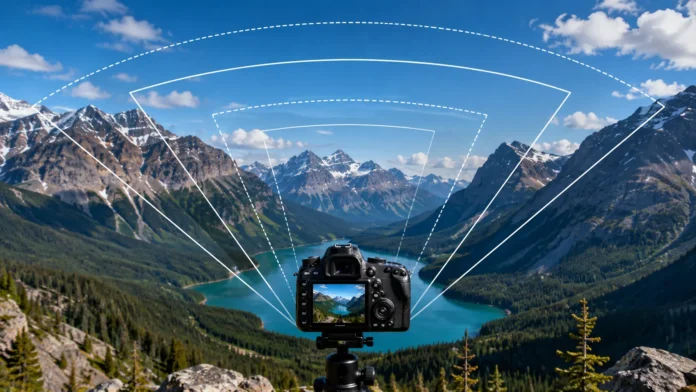

FOV Meaning: Field of View Explained With Examples
FOV stands for Field of View, the amount of a scene, environment, image, or visual area that can be seen at one time through a camera, screen, optical device, game, or human viewing system. Field of view is usually described as an angle measured in degrees, although some applications describe it as the width or diameter of the visible area at a specific distance. A wider FOV lets you see more of the surroundings, while a narrower FOV concentrates on a smaller section of the scene. The concept appears in photography, security cameras, gaming, virtual reality, binoculars, telescopes, microscopes, medical imaging, and many other technologies.
Understanding FOV is useful because the amount of visible scene can strongly affect usability, image composition, immersion, monitoring coverage, and object detail. A wide-angle security camera can observe a large room but may show distant objects at a smaller size. A gaming monitor with a wider virtual FOV can reveal more peripheral surroundings, while an excessively narrow setting can feel restrictive. Camera lenses also change field of view according to focal length and sensor size. This guide explains FOV meaning in simple terms, how field of view is measured, the main types of FOV, how it works in cameras and games, and practical examples that make the concept easy to understand.
What Does FOV Mean?
FOV means Field of View, or the portion of the observable world that can be seen through a visual system at one moment. Imagine looking through a narrow cardboard tube and then removing the tube completely. The tube creates a narrow field of view because only a small portion of the surroundings is visible, while removing it gives you access to a much broader scene. Cameras and optical systems follow the same basic principle. A narrow FOV isolates a smaller area, while a wide FOV includes more of what is happening to the left, right, above, or below.
Field of view is commonly expressed in degrees because the visible area expands outward from the viewer or lens. A camera with a horizontal FOV of 90 degrees can capture a much wider scene than one with a horizontal FOV of 40 degrees from the same position. However, the amount of physical area included also depends on distance. At short range, a 90-degree view might cover one room, while at a much greater distance it can cover a very large landscape. The FOV angle stays the same even though the physical width represented by that angle grows with distance.
The term is used slightly differently across industries. In photography, FOV usually describes how much of a scene a lens and sensor capture. In video games, it describes how much of the virtual environment appears on the screen. In binoculars, it may be described as an angular value or as a physical width visible at a particular distance. In microscopes, field of view can refer to the diameter of the circular area visible through the eyepiece. These definitions all share the same basic idea: they describe the extent of the scene visible at one time.
A wider field of view is not automatically better. Wide views provide greater situational awareness but can reduce the apparent size of individual objects. A very wide camera may show an entire parking lot while making a face or license plate too small to identify clearly. A narrow field of view provides less coverage but can make distant subjects appear larger when combined with appropriate optics. Choosing the right FOV therefore involves balancing coverage with detail. The ideal setting depends on what the user actually needs to observe.
FOV should also be distinguished from resolution. Resolution determines how many pixels or other information points are available to represent the visible scene, while FOV determines how much of that scene is included. Two cameras can both record 4K video but have very different fields of view because their lenses differ. Likewise, two games can run at the same screen resolution while using different FOV settings. Field of view and resolution work together, but they describe separate characteristics of visual systems.
How Is Field of View Measured?
Field of view is most commonly measured as an angle in degrees. The angle begins at the viewing point or optical center and extends toward the boundaries of the visible scene. A horizontal FOV measures the angle from the left edge to the right edge, while vertical FOV measures from top to bottom. Diagonal FOV measures between opposite corners. Because screens and camera sensors are usually rectangular, these three measurements can have noticeably different values. Manufacturers and software developers should ideally specify which type of FOV they are reporting.
Horizontal field of view is especially common in video games and surveillance systems because left-to-right awareness is often important. A player may care about seeing enemies approaching from the side, while a security camera installer may need to know how much of a hallway or entrance can be covered. A 100-degree horizontal FOV means the scene spans approximately one hundred angular degrees from the camera or player’s perspective. Increasing that value reveals more peripheral content. The exact visual result also depends on screen aspect ratio and software implementation.
Vertical FOV measures the amount visible from the bottom of the scene to the top. It becomes particularly relevant when viewing tall objects, multi-level spaces, stairways, high shelves, or immersive displays. In gaming, vertical FOV can vary depending on how the engine calculates the relationship between screen aspect ratio and the chosen horizontal setting. In security cameras, vertical coverage determines whether both the floor and upper wall remain visible. A wide horizontal angle with insufficient vertical coverage can still leave important blind areas.
Diagonal FOV runs from one corner of the image to the opposite corner and is often larger numerically than either horizontal or vertical FOV. Camera manufacturers sometimes advertise diagonal FOV because it produces the biggest-looking number, so users should check the specification carefully. A camera listed with a 120-degree diagonal view may have a noticeably narrower horizontal angle. Comparing products accurately therefore requires comparing the same measurement type. Horizontal-to-horizontal comparisons are more useful than comparing one product’s diagonal number with another product’s horizontal number.
Some optical products describe FOV as a physical width at a stated distance rather than only an angle. Binocular specifications might say that the viewer can see a certain width of landscape at 1,000 meters. This measurement can be converted into an angular field of view, but the physical-width format can feel more intuitive for users. Microscopes may describe field diameter in millimeters because the visible specimen area is extremely small. The measurement format changes, but the same question is being answered: how much of the scene can be seen without moving the device or viewpoint?
Horizontal, Vertical and Diagonal FOV
Horizontal FOV describes how far the view extends from side to side. This is often the most practical measurement for driving simulations, first-person games, security systems, and landscape-oriented cameras. A wider horizontal field gives greater awareness of objects approaching from the left and right. However, increasing the angle dramatically can create distortion near the edges, particularly when a flat display tries to represent an extremely broad virtual perspective. The ideal horizontal FOV depends on screen size, viewing distance, lens design, and the task being performed.
Vertical FOV describes how much is visible above and below the center of the view. It is generally smaller than horizontal FOV on a widescreen display because the screen is physically wider than it is tall. Vertical coverage becomes important for cameras mounted high on walls or ceilings because installers need to capture both nearby floor areas and more distant objects. In games, insufficient vertical FOV can make the image feel cramped, particularly on large displays. Ultra-tall or portrait-oriented screens change this relationship because screen geometry becomes different.
Diagonal FOV measures across the full rectangular frame and therefore includes both horizontal and vertical extent. It is commonly used in camera specifications, especially for webcams, action cameras, and security cameras. Because diagonal measurements are larger, they can make a lens sound wider than users may expect from the actual horizontal view. A product advertised with a 130-degree diagonal FOV might not provide a 130-degree side-to-side view. Users comparing devices should look for horizontal and vertical figures whenever precise coverage matters.
Aspect ratio links these measurements together. A 16:9 image, a 4:3 image, and an ultrawide 21:9 display cannot show identical horizontal, vertical, and diagonal angles unless the image is cropped or stretched in some way. Software may preserve vertical FOV while expanding horizontal FOV on wider displays, or it may preserve horizontal FOV and reduce vertical content. This difference explains why FOV behavior can vary between games even when players select similar settings. Understanding aspect ratio helps users interpret what the displayed FOV number actually controls.
The practical choice among horizontal, vertical, and diagonal FOV depends on the application. Security planners usually care about whether important doors, lanes, or objects fit within both horizontal and vertical coverage. Gamers often focus on horizontal FOV because peripheral awareness influences gameplay. Camera buyers may be given diagonal FOV in specifications but should examine actual sample images for a better sense of coverage. Engineers designing optical systems may calculate all three measurements precisely. No single FOV number describes every dimension of a rectangular image completely.
FOV in Cameras and Photography
In photography, field of view describes how much of the scene a camera captures through a particular lens and sensor combination. A wide-angle lens includes more surroundings, making it useful for landscapes, interiors, architecture, and situations where the photographer cannot move far away from the subject. A telephoto lens produces a narrower field of view and brings distant subjects into greater prominence. Wildlife, sports, and portrait photographers often use narrower views when they want the subject to fill more of the frame. FOV therefore directly influences composition and visual storytelling.
Focal length is one of the biggest factors controlling camera field of view. Shorter focal lengths generally create wider fields of view, while longer focal lengths produce narrower views. A 16 mm lens on a full-frame camera captures far more of the scene than a 200 mm lens used from the same position. The longer lens does not physically move the subject closer, but it records a smaller angular section of the scene and makes distant details occupy more of the image. This relationship is fundamental to lens selection.
Sensor size also affects the field of view produced by a given focal length. A 50 mm lens used on a full-frame sensor provides a wider view than the same focal length used on a smaller cropped sensor. The smaller sensor captures a smaller portion of the lens’s projected image, effectively narrowing the visible area. This is why photographers often discuss crop factor when comparing camera systems. The focal length remains physically unchanged, but the resulting field of view differs because the sensor dimensions have changed.
Wide-angle lenses can introduce perspective effects that users sometimes interpret as distortion. Objects near the edges may appear stretched, while subjects close to the camera can look disproportionately large compared with the background. Some distortion comes from lens design, while some results simply from using a wide viewpoint at close distance. Ultra-wide and fisheye lenses exaggerate these effects even further. Such characteristics can be creative tools in photography, but they may be undesirable when accurate proportions are important.
Camera FOV should also be considered alongside resolution. A wide 4K camera records many pixels, but those pixels are distributed across a larger scene. If the goal is identifying a small distant subject, a narrower lens may provide more usable detail because more pixels cover that subject. Security camera design frequently uses this principle. Covering an entire property with one extremely wide lens may create visual awareness but insufficient identification detail. Matching field of view with the required subject size produces more useful imagery.
FOV in Gaming
In gaming, FOV determines how much of the virtual world is displayed around the player’s viewpoint. First-person shooters, racing games, simulators, exploration games, and many other titles allow players to adjust the setting. A wider FOV reveals more of the environment on both sides, which can improve situational awareness. Players may spot opponents or obstacles earlier because more peripheral information appears on the screen. A narrow FOV shows less surrounding area but makes central objects appear larger. The best value depends on display setup, game design, personal comfort, and competitive priorities.
Low FOV can sometimes make players feel as though they are looking through a narrow window or zoomed-in camera. On a large monitor viewed from close distance, this effect can feel uncomfortable because the virtual perspective does not match the player’s natural expectation. Some people experience motion discomfort when the FOV is too narrow, particularly during rapid movement. Increasing the field can reduce that sensation for certain users. However, excessively high values can introduce strong stretching around the screen edges and make central objects appear unusually small.
Competitive players sometimes prefer a wider FOV because peripheral awareness can provide useful information. Seeing more of the environment can help detect movement that would otherwise fall outside the frame. The tradeoff is that opponents at long distance appear smaller because the same screen area represents a broader virtual scene. This can make precise targeting more difficult on small displays. Players therefore often experiment with several values before finding a balance between awareness and target visibility. There is no universally perfect gaming FOV.
Screen aspect ratio strongly affects how game FOV feels. Ultrawide monitors can naturally display more horizontal content when a game supports them correctly. Some game engines expand the horizontal view while preserving vertical framing, which creates an excellent ultrawide experience. Others crop the vertical image or stretch graphics, producing less desirable results. Multi-monitor racing and flight simulator setups can use extremely broad combined fields of view. These systems can create highly immersive peripheral vision when configured with correct screen angles and viewing distances.
Field of view can also influence perceived speed. Racing games with wider FOV settings often make roadside objects appear to move past the player more quickly, creating a stronger sense of motion. Narrower values can make movement feel slower even though vehicle speed in the game has not changed. This psychological effect explains why simulation enthusiasts carefully calculate FOV based on monitor size and viewing distance. Matching virtual perspective with the physical display can make a simulator feel more realistic rather than simply choosing the widest possible setting.
FOV in Virtual Reality and Augmented Reality
Virtual reality places field of view very close to the user’s eyes, making FOV one of the most important factors influencing immersion. A VR headset attempts to fill enough of the user’s vision that the display feels like an environment rather than a small screen. Wider headset FOV can reduce the sensation of looking through goggles or binoculars. However, increasing the field requires careful optical design, high-resolution displays, powerful rendering hardware, and comfortable lenses. Wider is beneficial only when image quality and usability remain acceptable.
Human vision extends well beyond the sharp central area that people actively focus on. Peripheral vision provides awareness of movement and spatial surroundings even though detail decreases toward the edges. VR systems try to reproduce enough of this broader visual range to create convincing presence. Headsets with narrow FOV can leave visible dark borders at the sides, reminding users that they are wearing a display. Wider systems reduce these borders but require more pixels and processing because more virtual content must be rendered simultaneously.
Resolution per degree becomes important in VR because total resolution is spread across the headset’s field of view. A headset with more pixels but a much wider FOV may not necessarily appear sharper than another headset with slightly lower total resolution and a narrower view. What matters is how many pixels represent each degree of the user’s vision. Optical clarity, lens design, display technology, and rendering also influence the experience. Comparing VR headsets therefore requires more than looking at one resolution or FOV specification.
Augmented reality has similar considerations because digital content must appear within the user’s real-world view. Some AR glasses provide a limited rectangular area where virtual objects can appear, even though the wearer can see the real environment much more broadly. A narrow AR FOV can cause large virtual objects to be clipped as the user looks around. Wider FOV allows digital information to occupy more of the natural view. Achieving this while keeping glasses lightweight and transparent remains a significant engineering challenge.
Comfort matters alongside immersion. A headset with theoretically wide FOV can still feel poor if lenses create blur, distortion, glare, or difficult eye positioning. Users also have different face shapes and eye distances, which can influence how much of the advertised field they actually experience. Manufacturers may report FOV using different methods, so direct numerical comparisons are not always perfect. Practical comfort and perceived visual quality remain as important as the headline angle when evaluating VR or AR devices.
FOV in Security Cameras and CCTV
Field of view is one of the most important specifications when selecting a security camera because it determines how much area one camera can monitor. A wide-angle camera can cover entrances, rooms, parking spaces, or corridors with fewer devices. This can reduce installation cost and simplify monitoring. However, wide coverage spreads available image resolution across more of the scene. A person standing far from the camera may therefore occupy only a small number of pixels. Security design needs to balance broad awareness with enough detail for the intended purpose.
A narrow FOV is useful when the camera needs to focus on a specific area such as a gate, cash register, doorway, or distant vehicle entrance. Telephoto lenses can capture a smaller scene while making subjects within that area appear larger. This can improve recognition and identification when the camera is positioned correctly. The limitation is reduced awareness outside the target zone. Installers often combine wide overview cameras with narrower detail cameras so one system provides both context and close-up evidence.
Lens focal length determines much of a CCTV camera’s field of view. Fixed-lens cameras have one permanent viewing angle, while varifocal cameras allow installers to adjust the lens within a range. A varifocal camera can therefore be tuned after installation to cover exactly the required doorway or lane. Motorized zoom models make adjustment even easier because technicians can change the view remotely. Choosing adjustable optics can be valuable when camera position is fixed but the optimal framing is uncertain during planning.
Mounting height changes how the field of view covers the scene. A camera installed high on a wall can see a larger area, but faces may appear at steep downward angles. A lower camera can capture better facial detail but may become easier to obstruct or tamper with. Vertical FOV becomes especially important when cameras are mounted overhead. Installers should verify that both nearby ground areas and more distant objects remain visible. Sample images from the actual mounting position provide more reliable information than specification sheets alone.
Resolution and FOV should always be planned together. A 4K camera with a 120-degree view may provide excellent general coverage, but a narrower 4K camera can devote many more pixels to a specific subject. Security professionals often think in terms of pixel density at the target distance rather than resolution alone. If the purpose is simply detecting that a person entered an area, wide coverage may be sufficient. If the purpose is identifying a face or plate, the view may need to be much narrower or the camera positioned closer.
FOV in Binoculars, Telescopes and Microscopes
Binocular field of view describes how much landscape can be seen through the eyepieces without moving the binoculars. It may be listed as an angle in degrees or as a width at a fixed distance, such as a certain number of meters visible at 1,000 meters. Wide-FOV binoculars are useful for birdwatching, sports, and observing moving subjects because the user can find and track objects more easily. Narrower views can make locating targets more difficult. Magnification and optical design influence how much field can be provided while maintaining good image quality.
Higher magnification binoculars often have narrower fields of view than lower magnification models. A 10× binocular typically shows less surrounding landscape than a similar 8× model, although lens and eyepiece design can change the exact result. The tradeoff is comparable with camera lenses: stronger magnification focuses on a smaller angular area. Birdwatchers sometimes prefer moderate magnification with a wide field because fast-moving birds are easier to locate. Long-distance observers may accept narrower coverage in exchange for greater apparent subject size.
Telescopes also use field of view to describe the portion of the sky visible through a particular eyepiece and optical setup. A wide-field telescope view can capture large star clusters or broad sections of the Milky Way, while a narrow field is useful for planets or small deep-sky objects. Changing eyepieces changes both magnification and the resulting true field of view. Astronomers therefore select combinations according to the target they want to observe. A telescope can have excellent magnification yet be frustrating for certain objects if its view is too narrow.
Microscope field of view operates at a much smaller physical scale. It refers to the diameter of the specimen area visible through the eyepiece. Increasing magnification usually decreases field of view, allowing the user to see more detail but less of the overall specimen. At low magnification, a large portion of a slide may be visible. At high magnification, only a tiny region remains in view. Students frequently use this relationship when estimating the size of microscopic objects.
These optical examples demonstrate the consistent tradeoff between coverage and magnification. Wide FOV helps locate and follow objects, while narrow FOV concentrates attention and can reveal greater apparent detail. The best choice depends on whether the user needs situational awareness or focused examination. Binoculars, telescopes, microscopes, cameras, and security systems all apply the same basic geometric idea at dramatically different scales. Understanding the relationship makes optical specifications much easier to compare.
Factors That Affect Field of View
Lens focal length is one of the strongest factors affecting optical field of view. Short focal lengths produce wider views, while longer focal lengths narrow the visible scene. This is true in photography, security cameras, binocular-related optical systems, and many specialized imaging devices. Changing focal length changes how much of the environment falls onto the sensor or through the optical path. Zoom lenses allow this relationship to be adjusted dynamically. A wider position reveals more surroundings, while zooming in progressively narrows the field and increases the apparent size of subjects.
Sensor size also matters in digital cameras. A larger sensor captures a wider portion of the image projected by a given lens than a smaller sensor when focal length remains unchanged. This is why the same 24 mm lens can behave differently across full-frame, APS-C, and smaller sensor systems. Photographers often use equivalent focal lengths to compare the resulting field of view between formats. The concept is particularly useful when switching between camera systems. Sensor size and focal length work together rather than independently.
Aspect ratio affects how the field is distributed horizontally and vertically. A widescreen 16:9 image naturally emphasizes horizontal coverage, while a square sensor distributes the image more evenly. Cropping an image changes the effective visible field even if the lens and camera position remain unchanged. Video modes can therefore produce different FOVs from still-photo modes when the camera crops part of the sensor. Smartphone cameras may also apply stabilization crops that slightly narrow the field during video recording. Users should evaluate actual output rather than assuming one lens always produces one fixed framing.
Viewing distance matters strongly for displays and simulation. A large monitor placed close to the user’s face occupies a greater physical angle of vision than the same monitor viewed from several meters away. Simulation enthusiasts use screen dimensions and viewing distance to calculate a realistic virtual FOV that matches the physical display. If the game shows far more virtual space than the monitor physically represents, geometry can look distorted. If it shows too little, the experience feels zoomed in. Correct perspective depends on the relationship between the viewer and the screen.
Software processing can also alter field of view. Digital stabilization may crop image edges so the software has space to compensate for camera movement. Lens-correction algorithms can stretch or crop wide-angle footage to reduce distortion. Smartphone camera apps may switch between physical lenses or crop sensors to create different zoom levels. Games can change FOV independently of physical optics because their scenes are rendered mathematically. Field of view is therefore influenced by both hardware and software depending on the application.
Wide vs Narrow FOV: Which Is Better?
A wide FOV is useful when awareness and coverage are priorities. Landscape photographers can include dramatic scenery, security cameras can observe larger areas, and gamers can see more peripheral action. Wide views are also valuable in cramped rooms where the camera cannot move far enough away from the subject. In virtual reality, greater FOV can enhance immersion by filling more of the user’s peripheral vision. The advantage is essentially more visual context. Users gain information about what surrounds the central subject.
The downside of a wide view is that individual subjects occupy less of the image when resolution remains constant. A person who fills half the frame in a narrow view may occupy only a small portion of a very wide frame. This can reduce identification detail and make distant objects harder to see. Extreme wide-angle views can also stretch edges or exaggerate perspective. In gaming, very high FOV can make opponents look smaller. The extra awareness therefore comes with a reduction in apparent scale.
A narrow FOV provides greater visual concentration. Telephoto photography can isolate wildlife or sports action, security cameras can focus on gates or cash registers, and telescopes can examine small celestial targets. Objects fill more of the viewing area, making details easier to inspect. Narrow framing also removes distracting surroundings and can create a stronger sense of subject emphasis. For identification tasks, this can be more valuable than broad coverage. The tradeoff is that activity outside the limited view remains unseen.
Neither wide nor narrow FOV should be treated as universally superior. The right choice depends on the goal, distance, available resolution, and environment. A hallway camera may need a moderate view aligned along the corridor, while a large open lobby may benefit from wider coverage. A racing simulator may need an accurately calculated field, while a competitive shooter player may prioritize peripheral awareness. Photography uses multiple lenses precisely because different compositions require different fields. Flexibility is often more useful than maximizing one extreme.
When choosing an FOV, start by asking what must be visible and how much detail is required. If recognizing a small subject matters, narrow the field or move the camera closer. If detecting activity across a large space matters more, use a wider field. For interactive displays, consider comfort and viewing geometry as well as awareness. A technically impressive FOV number does not guarantee better performance. The most useful FOV is the one that supports the intended task with enough coverage and enough detail simultaneously.
Common FOV Mistakes and Best Practices
One common mistake is comparing FOV specifications without checking whether they are horizontal, vertical, or diagonal. A camera advertised with 130 degrees may sound much wider than another listed at 100 degrees, but the first number could be diagonal while the second is horizontal. These measurements are not directly comparable. Buyers should look for consistent definitions or view sample footage before deciding. Manufacturers that provide all three measurements make comparison much easier. When only one value appears, check the documentation for how it was calculated.
Another mistake is assuming wider FOV automatically means better security coverage. A very wide camera may technically see an entire area while providing too little detail to identify the people inside it. Resolution must be distributed across the whole frame, so each subject receives fewer pixels as coverage expands. Security planners should define whether they need detection, recognition, or identification before choosing lens width. Sometimes two moderate-FOV cameras provide better evidence than one ultra-wide model. Coverage should be judged by usable detail rather than scene size alone.
Gamers sometimes choose extremely high FOV because they assume seeing more must always improve performance. A very wide setting can introduce edge stretching, reduce target size, and make the central view feel distant. The correct value depends on monitor dimensions, viewing distance, aspect ratio, and personal comfort. Simulation games can benefit from mathematically accurate perspective, while competitive games may justify some compromise for awareness. Players should test several settings rather than copying one number from another person’s setup.
Photographers can make a similar mistake by thinking field of view comes only from focal length. Sensor size, crop modes, aspect ratio, stabilization, and post-processing can all alter the final framing. A lens specification therefore needs to be interpreted within the camera system where it is used. Equivalent focal length is helpful when comparing different sensor formats. Sample images taken from the same position can also reveal the difference more intuitively than numbers alone. Understanding the complete optical system prevents unexpected framing.
The best practice across all FOV applications is to test the view under realistic conditions. Camera installers should check actual target distances, photographers should examine edge behavior, gamers should evaluate comfort during motion, and VR users should consider perceived clarity as well as advertised width. Numerical specifications are useful for planning, but human perception and real-world placement remain important. Field of view should ultimately serve the task. A balanced, tested configuration generally produces better results than simply selecting the widest or narrowest option available.
Conclusion
FOV stands for Field of View and describes how much of a scene or environment can be seen at one time. It is commonly measured in degrees and can be specified horizontally, vertically, or diagonally. A wide FOV includes more surroundings, while a narrow FOV concentrates on a smaller section of the scene. The concept appears across cameras, games, virtual reality, security systems, binoculars, telescopes, microscopes, and many other optical or digital technologies. Although the applications differ, the basic meaning remains consistent.
Field of view should not be confused with resolution or magnification. Resolution determines how much image information is available, while FOV determines how much of the scene that information covers. A wide high-resolution camera may still provide less detail on one distant face than a narrower camera using the same resolution. Magnification similarly concentrates on smaller areas while reducing coverage. These relationships explain why wide and narrow views each have advantages depending on the task.
In photography and CCTV, focal length and sensor size strongly influence the final field of view. Short lenses generally produce wider views, while longer lenses narrow the scene. In gaming, software settings determine how much of the virtual environment appears on the display. VR systems use FOV to describe how much of the user’s vision is filled by the headset. Optical devices such as binoculars and microscopes also use field measurements to describe the visible area. The same concept adapts naturally across very different technologies.
Choosing the right FOV requires balancing awareness with detail. Wide views are useful for landscapes, large security areas, immersive games, and situations where peripheral information matters. Narrow fields are better when users need to focus on distant subjects, capture identifiable details, or isolate specific objects. Extremely wide views can create distortion or make subjects too small, while very narrow views can feel restrictive and hide important context. The ideal field depends on viewing distance, resolution, optics, display geometry, and the actual goal.
Ultimately, understanding FOV makes technical specifications much easier to interpret. When you see a field-of-view value, first check whether it is horizontal, vertical, or diagonal. Then consider the lens, sensor, screen, distance, and application where that angle will be used. Avoid assuming that the largest number automatically provides the best experience. A useful field of view is one that shows enough of the surroundings while preserving the detail needed for the task. Once that balance is understood, cameras, games, VR headsets, and optical equipment become much easier to compare.
Frequently Asked Questions About FOV
What does FOV stand for?
FOV stands for Field of View. It describes how much of a scene, environment, or visual area can be seen at one time through a camera, display, optical device, or virtual viewpoint.
Is a higher FOV better?
Not always. A higher FOV shows more surroundings, but objects may appear smaller and edge distortion can become more noticeable. The best FOV depends on whether you prioritize broad awareness or detailed viewing.
What is the difference between horizontal and diagonal FOV?
Horizontal FOV measures the angle from the left side of the image to the right side. Diagonal FOV measures between opposite corners and usually produces a larger numerical value.
What affects a camera’s field of view?
The main factors include lens focal length, sensor size, aspect ratio, crop mode, and digital processing. Shorter focal lengths generally create wider fields of view, while longer lenses produce narrower views.
What is FOV in gaming?
In gaming, FOV determines how much of the virtual world is visible on the screen at once. A wider setting provides more peripheral awareness, while a narrower setting makes central objects appear larger.