

Ambient Temperature Definition: Meaning & Examples
Ambient temperature is the temperature of the air or surrounding environment around a person, object, machine, room, or piece of equipment. In simple terms, it tells you how hot or cold the immediate surroundings are rather than the internal temperature of a specific object. The term appears frequently in weather reports, electronics, HVAC systems, laboratories, manufacturing, storage, transportation, and everyday conversations about indoor comfort. If a laptop is operating in a room where the surrounding air is 24°C, that room temperature can be considered the laptop’s ambient temperature. Understanding ambient temperature is important because surrounding conditions can directly influence performance, safety, comfort, efficiency, and product stability.
Ambient temperature should not be confused automatically with room temperature, surface temperature, body temperature, or the internal operating temperature of equipment. A computer processor can reach 80°C even when the ambient air around the computer is only 23°C. A refrigerator can maintain an internal temperature near 4°C while the surrounding kitchen remains much warmer. Likewise, a metal surface exposed to sunlight can become much hotter than the surrounding outdoor air. This guide explains ambient temperature definition, meaning, common examples, how it is measured, what affects it, why it matters in electronics and buildings, and how it is used in storage, transportation, workplaces, and everyday environments.
What Is Ambient Temperature?
Ambient temperature is the temperature of the surrounding air in the environment where a person, object, or system is located. The word “ambient” means surrounding or present in the immediate environment, which is why the term is used to describe external thermal conditions. If a machine is running in a factory where the air around it is 30°C, then approximately 30°C is its ambient temperature. The internal parts of the machine may be much hotter because motors, processors, bearings, or electrical components generate heat. Ambient temperature therefore provides the environmental baseline rather than the temperature of the object itself.
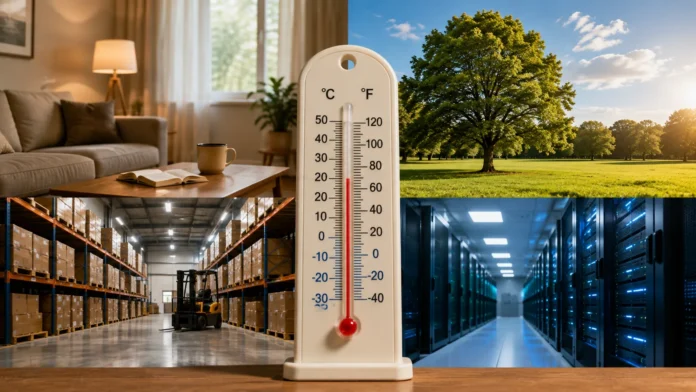
The concept applies to both indoor and outdoor environments. Indoors, ambient temperature can describe the air inside a home, office, warehouse, laboratory, server room, or vehicle. Outdoors, it generally refers to the surrounding air temperature in a particular location rather than the temperature of roads, walls, soil, or objects exposed directly to sunlight. Outdoor conditions can change quickly throughout the day because of weather, wind, cloud cover, and solar heating. Indoor conditions may remain more stable when heating, ventilation, and air-conditioning systems regulate the space.
Ambient temperature is not one universal numerical value. A common misunderstanding is assuming that “ambient” always means something like 20°C or 25°C. In reality, the ambient temperature of a cold-storage warehouse could be close to freezing, while the ambient temperature near industrial machinery could exceed 35°C. The correct value depends entirely on the environment being described. When temperature limits matter, product instructions and technical specifications usually provide an explicit numerical range rather than relying only on the word ambient.
The term is especially useful in engineering because equipment performance depends strongly on surrounding conditions. Manufacturers often specify that a device should operate within a particular ambient temperature range, such as 0°C to 40°C. This means the air around the equipment should remain within those limits, even though internal components may operate at much higher temperatures. If ambient air rises beyond the recommended maximum, cooling systems may struggle to remove internally generated heat. This can lead to reduced performance, faster wear, or automatic shutdown.
A simple way to remember ambient temperature is to ask, “What is the temperature around it?” If the subject is a smartphone, ambient temperature means the air around the phone. If the subject is a warehouse, it means the air inside that warehouse. If the subject is outdoor machinery, it means the surrounding outdoor air. This definition is broad enough to apply across electronics, weather, HVAC, manufacturing, storage, transportation, and daily life. The surrounding temperature may seem simple, but it can have important effects on how people, products, and equipment behave.
Ambient Temperature vs Room Temperature
Ambient temperature and room temperature are often used interchangeably in everyday language, but technically they are not always identical. Room temperature usually refers to a comfortable indoor temperature range in occupied spaces such as homes, offices, classrooms, or shops. Ambient temperature is broader because it can describe almost any surrounding environment, whether indoors, outdoors, refrigerated, heated, or industrial. A server room, factory floor, or vehicle cabin all have ambient temperatures even if those temperatures would not be considered comfortable room temperature for people.
Room temperature also tends to imply a relatively moderate range suitable for normal human activity. Many people think of room temperature as somewhere around the low-to-mid 20s Celsius, although actual comfort varies by climate, clothing, season, humidity, and individual preference. Ambient temperature makes no such assumption. A warehouse at 34°C still has an ambient temperature of 34°C even though the environment may feel uncomfortably hot. The term describes what the surrounding air is actually doing rather than what people consider comfortable.
Technical documentation usually prefers ambient temperature because equipment can be installed in many different environments. A network switch may operate in an air-conditioned office, a hot utility room, or a factory cabinet. The manufacturer therefore provides an allowable ambient operating range that applies regardless of human comfort. This information helps installers determine whether additional cooling or ventilation is needed. A device rated for a maximum ambient temperature of 40°C may not be suitable for a sealed enclosure that regularly reaches 50°C.
Room temperature can also be influenced by building design and HVAC settings. Two rooms in the same building may have different ambient temperatures because one receives direct afternoon sunlight while another remains shaded. Occupancy, computers, lighting, appliances, and ventilation can create further differences. A thermostat mounted in one location does not always represent the ambient conditions experienced throughout the entire space. Larger buildings therefore use several sensors and control zones to manage temperature more accurately.
For ordinary conversation, using ambient temperature and room temperature as approximate synonyms usually causes little confusion. In technical, scientific, storage, or safety-related contexts, however, the distinction becomes more important. Readers should always look for actual numerical limits when a product or process depends on temperature. “Store at ambient temperature” may still need additional clarification if the item is sensitive to heat. Specific ranges provide far more reliable guidance than assuming ambient always means a comfortable indoor environment.
How Is Ambient Temperature Measured?
Ambient temperature is usually measured with a thermometer or electronic sensor placed where it can represent the surrounding air accurately. The sensor should generally be located away from direct sunlight, heaters, cold air vents, machinery exhaust, and other local influences that could distort the reading. If a thermometer is positioned beside a hot radiator, it may report a temperature that is much warmer than the room as a whole. Proper placement helps ensure the measurement reflects the environment being evaluated rather than one unusually hot or cold spot.
Several types of temperature sensors can be used depending on the application. Household environments may rely on simple digital thermometers or thermostat sensors, while industrial systems can use thermocouples, resistance temperature detectors, thermistors, or semiconductor sensors. Laboratories may require calibrated instruments with much greater precision. Building-management systems often use networked sensors that continuously report temperature to a central controller. The correct sensor depends on the required accuracy, environmental range, cost, and whether continuous monitoring is necessary.
Airflow can significantly affect measurements. A sensor placed directly in front of an air-conditioning vent may report a much lower value than the surrounding occupied area. Similarly, a sensor positioned above heat-producing equipment may indicate an unusually high temperature. Large rooms can contain several different temperature zones because warm air rises and cooler air may collect near floors or ventilation outlets. Multiple sensors provide a more accurate picture when conditions vary across the space. This is particularly important in warehouses, server rooms, laboratories, and manufacturing facilities.
Time is another important factor because ambient temperature can fluctuate. Outdoor temperatures change throughout the day, while indoor temperatures may rise and fall as HVAC systems cycle, people enter or leave, and equipment operates. One manual reading provides only a snapshot. Continuous monitoring shows patterns such as afternoon heat peaks or overnight cooling. Businesses managing sensitive products or critical equipment often record minimum, maximum, and average temperatures over time. This historical information can help explain failures or quality problems that would be missed by occasional checks.
Ambient temperature is commonly expressed in degrees Celsius or degrees Fahrenheit, depending on the region and industry. Scientific calculations may also use Kelvin when absolute temperature is required. It is important to confirm the unit whenever reading technical specifications because 30°C and 30°F represent completely different conditions. Good measurement therefore depends on more than owning a thermometer. Correct sensor placement, proper units, suitable equipment, and enough observation time all contribute to an accurate understanding of ambient conditions.
Common Examples of Ambient Temperature
A living room provides one of the simplest examples. If a thermostat shows 23°C and the air is reasonably well mixed, that value can represent the ambient temperature around the people, furniture, electronics, and other objects in the room. A television may become warmer while operating, but the room itself remains around 23°C. The television releases some heat into the surrounding air, and that air helps cool the device. This everyday interaction demonstrates the difference between the temperature of an object and the temperature around it.
A parked car is another useful example because its interior ambient temperature can become much hotter than the outdoor weather reading. Sunlight enters through the windows and heats seats, dashboards, and other surfaces, which then warm the enclosed air. Even if the outdoor air temperature is 30°C, the inside of a closed vehicle can become much hotter. Electronics, food, batteries, and other items left inside therefore experience a very different ambient environment from the one reported by a weather service.
A refrigerator illustrates the opposite situation. The kitchen may have an ambient temperature of 24°C, while the inside of the refrigerator remains around a few degrees Celsius. The appliance removes heat from its internal compartment and releases that heat into the surrounding kitchen. If the kitchen becomes very hot, the refrigerator has to work harder to maintain its cold internal temperature. This increases compressor runtime and energy use. The example shows how ambient temperature can influence the performance of equipment designed to maintain a completely different internal environment.
Outdoor equipment also demonstrates why ambient temperature matters. A generator operating in 38°C air has less opportunity to release heat than the same generator running in 15°C air. The engine and electrical components create substantial internal heat in both cases, but hotter surroundings make cooling more difficult. Equipment manufacturers therefore provide ambient operating limits so users know the conditions under which the machine can perform safely. High ambient heat may require reduced load, better airflow, or additional cooling.
A smartphone offers another familiar example. Playing games, recording video, using navigation, or charging quickly can generate significant internal heat. If the phone is also sitting in direct sunlight on a hot day, the high ambient temperature makes it harder for the device to cool itself. The phone may reduce screen brightness, slow charging, lower processor performance, or display a temperature warning. Moving the device into a cooler shaded environment reduces ambient temperature and improves heat dissipation.
Why Ambient Temperature Matters for Electronics
Electronic devices generate heat as processors, power supplies, batteries, memory, displays, and other components consume electricity. Ambient temperature affects how easily this heat can move away from the device. When the surrounding air is cool, there is a larger temperature difference between hot components and the environment, making cooling more effective. When ambient air is already very warm, the temperature difference becomes smaller. This can cause internal temperatures to rise even when the cooling system itself has not changed.
Computers provide a clear example because processors and graphics chips can become very hot under heavy workloads. Fans, heat sinks, and liquid-cooling systems transfer that heat toward the surrounding air. If the room temperature rises from 20°C to 35°C, the cooling system has much less thermal headroom. Internal component temperatures will generally rise as well. Modern processors may automatically reduce speed when temperatures approach safe limits, a behavior known as thermal throttling. This protects the hardware but can reduce performance.
Batteries are also sensitive to ambient conditions. High heat can accelerate chemical aging and reduce long-term battery life, while very cold environments can temporarily reduce available capacity and performance. Smartphones, laptops, power tools, electric vehicles, and backup systems all use batteries that behave differently across temperature ranges. Charging can also be restricted when temperatures are too high or low. Battery-management systems may slow or stop charging to protect the cells. Keeping devices within recommended ambient conditions can therefore improve both performance and longevity.
Networking and data-center equipment rely heavily on controlled ambient temperature because large numbers of servers generate enormous amounts of heat. Cooling systems must remove this heat continuously to prevent local hot spots. Even when the overall room temperature appears acceptable, poor airflow can cause the air entering one server rack to become much warmer than expected. Temperature sensors are therefore placed at multiple locations throughout critical facilities. Maintaining stable ambient conditions supports reliability, energy efficiency, and predictable performance.
Cold environments can also create problems for electronics. Batteries can lose temporary capacity, mechanical parts may behave differently, and condensation can appear when cold equipment is moved suddenly into warm humid air. This is why manufacturers specify both minimum and maximum ambient operating conditions. Consumer devices may have narrower ranges than industrial equipment designed for outdoor or factory use. The best practice is to treat ambient temperature as part of the operating environment rather than assuming electronics will behave identically everywhere.
Ambient Temperature in HVAC and Buildings
Ambient temperature is central to HVAC systems because heating and cooling equipment exists partly to maintain comfortable indoor conditions. Thermostats and sensors measure the surrounding air and compare it with the selected temperature setpoint. If the room becomes warmer than the cooling target, the air-conditioning system may start. If it becomes colder than the heating target, the heating system activates. Accurate sensing is important because poor sensor placement can cause the system to react to conditions that do not represent the occupied space.
Thermal comfort depends on more than ambient air temperature alone. Humidity, air movement, clothing, activity level, and temperatures of surrounding surfaces all influence how people feel. Two offices can both measure 24°C while one feels comfortable and the other feels warm because humidity or sunlight differs. Strong airflow can make people feel cooler even without changing the actual air temperature significantly. HVAC design therefore considers several environmental factors rather than relying on temperature alone. Ambient temperature remains one of the most important variables, but it is part of a larger comfort system.
Outdoor ambient temperature strongly influences building energy use. On a very hot day, heat enters through roofs, windows, walls, doors, and ventilation air, increasing the cooling load. During cold weather, buildings lose heat to the environment and require additional heating. The greater the difference between indoor and outdoor temperatures, the more energy HVAC systems generally need to maintain comfort. Insulation, shading, efficient windows, and air sealing reduce this heat transfer. Building design therefore affects how much effort is needed to control indoor ambient conditions.
Commercial buildings often contain several temperature zones because different areas have different heat loads. A server room may remain warm even in winter because computers continuously release heat, while a warehouse near loading doors can experience strong outdoor influence. Offices, kitchens, conference rooms, and manufacturing areas also have very different occupancy and equipment patterns. Zoned HVAC allows each area to be controlled according to its own ambient conditions. Using one temperature sensor for an entire large building would rarely provide good comfort everywhere.
Energy-management systems increasingly monitor ambient temperature alongside occupancy and equipment schedules. Heating or cooling can be reduced in unoccupied areas and increased only when needed. Smart controls can also respond to outdoor weather conditions and building thermal behavior. The goal is to maintain acceptable comfort while avoiding unnecessary energy use. Understanding ambient temperature therefore supports not only comfort but also building efficiency, equipment sizing, and operational cost management.
Ambient Temperature in Storage and Transportation
Storage conditions matter because temperature can affect the quality, stability, and usable life of many products. Food, medicines, batteries, chemicals, cosmetics, electronics, and industrial materials can all have recommended storage ranges. Some products require refrigeration, while others are designed for controlled ambient storage. The phrase “ambient storage” does not mean that any temperature is acceptable. Businesses should follow the numerical storage range provided for the specific item rather than assuming all room-like environments are suitable.
Food storage provides a familiar example. Shelf-stable products can usually remain at normal indoor ambient conditions, while refrigerated and frozen products require much colder environments. Heat can accelerate spoilage, chemical changes, and quality loss in certain foods. Warehouses and delivery vehicles therefore need appropriate environmental controls according to the products they handle. Temperature management extends beyond the warehouse because products may spend hours inside trucks, loading docks, or temporary holding areas before reaching customers.
Medicines can also be sensitive to temperature. Some products are designed for controlled room conditions, while others require refrigeration or protection from freezing. Excessive heat can reduce stability even when packaging appears normal. Healthcare supply chains may use temperature data loggers during shipping so distributors can verify that conditions remained acceptable. These monitoring systems record the ambient temperature experienced by the package over time. Temperature control therefore becomes part of product-quality assurance.
Electronic products and batteries benefit from suitable storage conditions as well. High ambient heat can accelerate battery aging even when devices are not being used. Large changes in temperature can also create condensation risks, especially when cold equipment is moved into warmer humid spaces. Warehouses storing expensive electronics may therefore manage both temperature and humidity. Packaging helps, but environmental control remains important for long-term storage. Manufacturer-recommended ranges should always take priority over general assumptions.
Transportation can expose products to more extreme ambient temperatures than normal indoor storage. Closed delivery vehicles can become very hot in direct sunlight, while winter transportation can expose goods to freezing conditions. Shipping containers, trucks, aircraft, and last-mile delivery vehicles can each create different thermal environments. Temperature-sensitive supply chains use insulated packaging, refrigerated transport, controlled facilities, and monitoring devices to manage these risks. Ambient temperature is therefore an important consideration throughout the entire logistics process, not only at the final storage destination.
Factors That Affect Ambient Temperature
Sunlight is one of the strongest factors affecting local temperature. Surfaces absorb solar radiation and convert it into heat, which can warm nearby air. A room receiving direct afternoon sun may become significantly warmer than another room in the same building. Outdoor thermometers placed in direct sunlight can also produce misleading readings because the instrument itself becomes heated. Accurate ambient measurements should therefore be protected from direct radiation when the goal is to measure air temperature rather than surface heating.
Airflow influences how heat spreads through an environment. Fans, ventilation systems, open windows, and natural wind can mix air and reduce local hot or cold spots. Without enough circulation, warm air can collect near ceilings while cooler air remains closer to the floor. Server cabinets can become dangerously hot when airflow is blocked even though the surrounding room feels comfortable. Air movement does not always change the measured temperature dramatically, but it strongly affects heat transfer and human comfort.
Heat-producing equipment can raise ambient temperature locally. Computers, ovens, motors, industrial machines, lighting, and people all release heat into the surrounding environment. A crowded meeting room can become warmer than an empty one because every person adds heat. Data centers and factories can experience much larger internal heat loads from equipment operating continuously. HVAC and ventilation systems must be designed to remove this heat efficiently. Ambient conditions therefore depend not only on outdoor weather but also on what is happening inside the space.
Building materials influence temperature stability. Insulation slows heat transfer between indoors and outdoors, while windows can allow substantial solar and conductive heat gain. Heavy materials such as concrete can absorb heat and release it slowly, affecting temperature patterns throughout the day. Roof color, shading, air leakage, and wall construction all influence indoor ambient conditions. Better building envelopes reduce temperature swings and make HVAC systems more efficient. Poor insulation can make indoor temperature closely follow outdoor extremes.
Humidity interacts with temperature even though it does not directly change the dry-bulb temperature reading. High humidity can make warm air feel hotter because sweat evaporates less effectively, while low humidity can increase evaporative cooling. Humidity also affects condensation, corrosion, and material stability. For this reason, technical specifications often list both ambient temperature and relative humidity. Complete environmental control usually requires considering several conditions together rather than using one temperature number in isolation.
Best Practices for Monitoring Ambient Temperature
The first best practice is placing sensors where they represent the environment being monitored. Avoid installing temperature sensors directly beside heaters, cold vents, windows, machinery exhaust, or sunlight unless those specific local conditions are what you need to measure. In a warehouse, sensors should be distributed across representative zones rather than concentrated near one wall. In a server room, inlet-air temperatures near equipment can be more useful than one central thermostat. Correct placement improves the quality of every decision based on the data.
Use continuous monitoring when temperature affects critical equipment, products, or operations. Manual checks once or twice per day can miss short periods of excessive heat or cold. Digital data loggers and building-management systems can record readings continuously and send alerts when values leave acceptable limits. Historical trends also help identify recurring problems, such as afternoon overheating or HVAC performance declining over time. Monitoring becomes much more useful when it supports early intervention rather than simply documenting a failure after it happens.
Define acceptable ranges in advance. A temperature alert is only useful when everyone knows what values are considered normal, concerning, or critical. Equipment manuals, product storage instructions, and facility requirements can help establish these limits. Businesses should also define who receives an alert and what action they should take. If a warehouse temperature exceeds a product limit, staff may need to inspect HVAC equipment, move inventory, or escalate the problem. Clear response procedures turn measurements into operational protection.
Calibrate sensors when accuracy matters. Cheap consumer thermometers can be adequate for ordinary home use but may not provide the precision required in laboratories, healthcare, manufacturing, or regulated storage. Over time, sensors can drift and report slightly incorrect readings. Calibration compares the device against a known standard and confirms whether adjustment or replacement is necessary. The required calibration frequency depends on the application and risk. Critical environments generally need stronger measurement controls than ordinary offices.
Finally, evaluate temperature together with context. A single number does not always explain why conditions changed or whether an object is actually at risk. Airflow, humidity, sunlight, operating load, equipment placement, and duration of exposure can all matter. A brief increase to 30°C may have different consequences from several days at the same temperature. Monitoring systems should therefore help users understand patterns rather than generating isolated readings without explanation. Good ambient-temperature management combines measurement, thresholds, context, and action.
Conclusion
Ambient temperature is the temperature of the surrounding air or environment around a person, object, machine, room, or process. It provides a baseline for understanding how external thermal conditions can affect comfort, equipment performance, storage quality, and physical processes. Ambient temperature does not describe the internal temperature of the object itself. A laptop processor, refrigerator compartment, or engine can operate at temperatures very different from the air around it. This distinction is essential when interpreting technical specifications and operating limits.
Ambient temperature is broader than room temperature. Room temperature generally suggests normal indoor comfort, while ambient temperature can describe almost any environment, including warehouses, server rooms, factories, outdoor locations, refrigerated spaces, and vehicles. There is no single universal ambient value such as 20°C or 25°C. The number depends on the actual surroundings. When safety, performance, or storage conditions matter, specific temperature ranges should always take priority over informal assumptions.
Accurate measurement requires appropriate sensors and careful placement. Direct sunlight, air vents, heaters, machinery, and poor airflow can create readings that do not represent the wider environment. Large spaces may require multiple sensors, while critical facilities can benefit from continuous monitoring and automatic alerts. Historical temperature trends can reveal problems that occasional manual checks miss. Correct units and calibration also become important when precision is required.
Ambient temperature matters strongly in electronics, HVAC, buildings, storage, and transportation. High surrounding temperatures can increase internal equipment temperatures, reduce cooling efficiency, and accelerate battery aging. Buildings consume more energy when indoor and outdoor conditions differ significantly. Sensitive products can lose quality when storage or shipping temperatures move outside recommended ranges. Managing the environment can therefore improve reliability, efficiency, safety, and product stability.
Ultimately, ambient temperature answers one simple question: what is the temperature around the thing being considered? That question applies to everything from a smartphone on a desk to a server rack, warehouse, delivery vehicle, or outdoor machine. Once the distinction between surrounding temperature and internal temperature is clear, technical requirements become easier to understand. Measuring ambient temperature accurately and comparing it with appropriate limits helps ensure that people, equipment, and products remain in suitable conditions.
Frequently Asked Questions About Ambient Temperature
What is ambient temperature in simple terms?
Ambient temperature is the temperature of the air or environment surrounding a person, object, or device. It describes external conditions rather than the internal temperature of the object itself.
Is ambient temperature the same as room temperature?
Not always. Room temperature usually refers to comfortable indoor conditions, while ambient temperature can describe indoor, outdoor, industrial, refrigerated, or other surrounding environments.
What is a normal ambient temperature?
There is no single universal ambient temperature because it depends on the location and environment. For equipment or storage, always use the specific operating or storage range provided by the manufacturer or product instructions.
Why is ambient temperature important for electronics?
Ambient temperature affects how easily electronic devices can release the heat they generate. Higher surrounding temperatures can increase internal temperatures and may reduce performance, battery life, or long-term reliability.
How do you measure ambient temperature?
Use a suitable thermometer or temperature sensor placed away from direct sunlight, heaters, cold vents, and other local heat sources. In larger or sensitive environments, multiple sensors or continuous monitoring can provide more reliable results.