
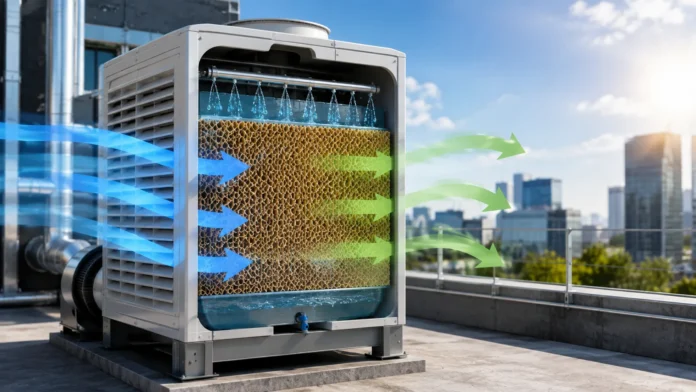

Adiabatic Cooling: How It Works & Why It Saves Energy
Adiabatic cooling is a method of reducing air temperature by using a thermodynamic process in which heat is exchanged internally rather than being removed through a conventional refrigeration cycle. In many practical HVAC and industrial applications, the term refers to cooling created when water evaporates into air and absorbs sensible heat. As evaporation occurs, the air temperature falls while its moisture content may increase, depending on the system design. This process can require significantly less electrical energy than compressor-based mechanical cooling under suitable conditions. Adiabatic cooling is therefore widely considered for warehouses, factories, commercial buildings, data centers, and other facilities where large quantities of air need to be cooled efficiently.
The technology can be simple or highly engineered. Some systems introduce water directly into an airstream, while others use evaporation on one side of a heat exchanger so the supply air is cooled without receiving additional moisture. Hybrid equipment can combine adiabatic cooling with conventional chillers or refrigeration to reduce compressor use during favorable weather and provide additional cooling when outside conditions become more demanding. Performance depends strongly on outdoor temperature, humidity, water quality, airflow, equipment design, and maintenance. Understanding these factors helps explain why adiabatic cooling can produce excellent energy savings in dry climates but may provide smaller benefits during humid conditions. This guide explains how the process works, where it is used, and how to apply it effectively.
What Is Adiabatic Cooling?
Adiabatic cooling is a temperature-reduction process associated with changes that occur without the system relying primarily on external heat removal in the conventional refrigeration sense. In HVAC applications, the term most commonly describes evaporative processes where water changes from liquid to vapor by absorbing heat from surrounding air. The energy used for evaporation comes from the air itself, causing the air’s dry-bulb temperature to decrease. Instead of operating a compressor to move heat through a refrigerant circuit, the system uses water evaporation and airflow to achieve cooling. This difference is one reason adiabatic systems can consume much less electricity than conventional air-conditioning equipment under favorable environmental conditions.
The word “adiabatic” comes from thermodynamics and technically describes a process involving no net heat transfer across the defined system boundary. Real cooling equipment is not always perfectly adiabatic because actual systems experience heat transfer, pressure losses, pump energy, fan heat, and other practical effects. Nevertheless, the term remains widely used to describe evaporative cooling processes where sensible heat in the air is converted into latent heat associated with water vapor. The total heat content of the air-water mixture can remain approximately similar while temperature and humidity change. This distinction is useful because adiabatic cooling does not remove heat in exactly the same way as a refrigeration system rejects heat outdoors.
A familiar example is the cooling sensation produced when water evaporates from wet skin. The liquid requires energy to become vapor, and some of that energy is taken from the surrounding surface and air. The result is a reduction in sensible temperature. An adiabatic cooler uses the same fundamental principle on a controlled scale by passing air across wetted media, introducing fine water droplets, or using evaporation within a separate heat-exchange process. Fans move air while water-management systems maintain the required moisture conditions. The effectiveness depends on how much additional water the air can absorb before approaching saturation.
Adiabatic cooling is closely related to evaporative cooling, and the two terms are often used interchangeably in building-services discussions. However, not every evaporative system delivers moisture directly into occupied spaces. Direct evaporative coolers add water vapor to the supply air, while indirect systems use evaporation to cool another airstream or heat-transfer surface. Indirect designs can therefore reduce temperature without raising indoor humidity as much. Hybrid systems may combine direct and indirect stages or pair adiabatic cooling with conventional refrigeration. Understanding these variations is important because comfort, process requirements, and local climate determine which approach is most appropriate.
The technology is particularly attractive where large airflow rates are required and outdoor air is relatively dry. Factories, workshops, warehouses, sports facilities, data centers, and agricultural buildings may need cooling across large spaces that would be expensive to condition using conventional refrigeration alone. Adiabatic systems can often move substantial volumes of cooled air while using electricity mainly for fans, pumps, and controls. The tradeoff is that cooling capacity depends on atmospheric moisture conditions rather than being fully independent of weather. A properly designed system therefore begins with local climate data and realistic performance expectations.
How Adiabatic Cooling Works
The core mechanism begins with the difference between sensible heat and latent heat. Sensible heat is associated with a measurable change in air temperature, while latent heat is associated with a phase change such as liquid water becoming vapor. During direct evaporative cooling, warm unsaturated air passes through or around water. Some of that water evaporates, requiring energy. The necessary energy is drawn largely from the sensible heat of the airstream, so the air temperature decreases while its moisture content increases. This conversion explains how cooling can occur without a conventional vapor-compression refrigeration cycle removing an equivalent amount of heat from the space through a condenser.
Wet-bulb temperature provides an important indication of the theoretical cooling limit for direct evaporative systems. Dry-bulb temperature is the ordinary air temperature measured by a standard thermometer, while wet-bulb temperature reflects the cooling potential available through evaporation. When air is hot and dry, the difference between dry-bulb and wet-bulb temperatures can be substantial, providing strong evaporative cooling potential. When the air is already humid, the difference becomes much smaller because the air cannot absorb much additional moisture. A direct adiabatic cooler therefore cannot normally reduce supply-air temperature below the entering-air wet-bulb temperature without additional cooling stages.
The equipment encourages efficient contact between air and water. In a wetted-media system, air passes through a porous pad kept evenly moist by a recirculating water circuit. As the air moves through the large wet surface area, some water evaporates and cools the airstream. Other designs use atomizing nozzles that create very small droplets with enough surface area to evaporate quickly. High-pressure systems can produce fine mist for rapid evaporation, while simpler spray arrangements may suit particular industrial applications. Good design tries to maximize evaporation while preventing unwanted liquid droplets from being carried downstream.
Fans are required to move the cooled air through the building or process, while pumps circulate or pressurize water. Controls monitor temperature, humidity, airflow, water level, and equipment condition so the system operates only when adiabatic cooling will provide useful results. Variable-speed fans can adjust airflow according to demand, and valves can regulate water flow to avoid unnecessary consumption. In hybrid installations, controls may decide whether to use dry cooling, adiabatic assistance, or mechanical refrigeration depending on outdoor conditions and the required supply temperature. Intelligent sequencing is a major part of achieving the expected energy savings.
In indirect systems, evaporation takes place in a secondary airstream rather than directly in the supply air. The evaporation cools a heat exchanger, and the heat exchanger then reduces the temperature of the separate supply airstream. Because the two airstreams remain separated, the supply air gains far less additional moisture. This can be valuable in offices, data centers, manufacturing processes, or other environments where humidity control matters. Indirect systems may produce slightly less temperature reduction than direct evaporative cooling under similar conditions, but they provide greater control over indoor moisture. Multi-stage systems can combine both methods to gain additional cooling capacity.
Direct vs Indirect Adiabatic Cooling
Direct adiabatic cooling is the simplest approach because the air being supplied to the space comes into direct contact with evaporating water. Warm outside air is drawn through wetted media or another evaporation device, allowing its temperature to fall while humidity rises. The cooled air is then delivered into the building, often at relatively high airflow rates. This method can provide excellent efficiency in hot and dry climates because the outdoor air has substantial capacity to absorb moisture. Direct systems are commonly associated with evaporative coolers used in warehouses, workshops, agricultural facilities, and large open commercial or industrial spaces where some increase in humidity is acceptable.
The main limitation of direct cooling is that moisture becomes part of the supply air. This can be beneficial in extremely dry environments where indoor air would otherwise feel uncomfortable, but it can become undesirable when humidity is already high. Certain manufacturing processes, storage environments, electronics rooms, and comfort applications require tighter humidity control. Excessive moisture can also increase condensation risk when surfaces are cool enough. Engineers therefore evaluate both temperature and humidity rather than looking only at the expected supply-air temperature. Psychrometric analysis is commonly used to understand how the air condition will change through the evaporation process.
Indirect adiabatic cooling separates the evaporation process from the air supplied to the occupied or controlled space. A secondary airstream is cooled through evaporation and used to remove sensible heat from the primary supply air through a heat exchanger. The primary air therefore becomes cooler without absorbing the same amount of moisture it would receive in a direct system. This design expands the usefulness of adiabatic cooling into applications where humidity limits are stricter. Data centers, offices, commercial facilities, and industrial processes can benefit from this separation, particularly when outdoor conditions provide good evaporative potential but direct moisture addition would create operational concerns.
Two-stage systems can combine indirect and direct evaporative cooling for greater temperature reduction. In the first stage, indirect cooling lowers the temperature of the incoming supply air without substantially increasing its moisture content. Because the air becomes cooler while remaining relatively dry, a second direct stage can then provide additional evaporative cooling. This arrangement can produce supply temperatures closer to comfort requirements while still avoiding the large compressor loads associated with conventional air conditioning. The design becomes more complex than a single direct stage, but the additional efficiency can be valuable in large installations with long operating hours.
Hybrid adiabatic systems combine evaporative technology with mechanical refrigeration or dry heat rejection. During mild or dry weather, adiabatic cooling may handle most or all of the required load. As temperature or humidity increases, mechanical cooling can provide the remaining capacity. This arrangement gives operators greater reliability across changing seasonal conditions while allowing compressors to remain off or operate at reduced load for many hours. Hybrid systems are particularly useful when a facility cannot tolerate temperatures exceeding a strict limit. Instead of choosing between evaporative and refrigeration technologies, engineers can use each one during the conditions where it performs most effectively.
Where Adiabatic Cooling Is Used
Industrial facilities are common applications because they often contain large open spaces with significant heat gains from machinery, lighting, workers, and manufacturing processes. Cooling an entire factory using conventional refrigerated air conditioning can require enormous equipment capacity and electrical power. Direct adiabatic cooling can provide high volumes of cooler outdoor air using relatively modest electrical energy where humidity conditions are suitable. The continuous introduction of fresh air can also support ventilation requirements. Workshops, assembly areas, production halls, and loading facilities may benefit particularly when the objective is reducing heat stress rather than maintaining extremely precise indoor temperature and humidity.
Warehouses and distribution centers can also benefit because their large floor areas and high ceilings make conventional air conditioning expensive. Workers may spend long shifts picking, packing, loading, or managing inventory, and indoor temperatures can become uncomfortable during hot weather. Adiabatic cooling can deliver high airflow and reduce perceived heat while avoiding the electrical demand of large compressor systems. Strategic air distribution becomes important so cooled air reaches occupied zones rather than remaining near the roof. Facilities storing moisture-sensitive products still need careful humidity assessment, making indirect or hybrid approaches preferable in some cases.
Data centers increasingly use adiabatic or evaporative assistance because cooling can represent a significant portion of facility energy use. Servers convert electrical power into heat continuously, requiring dependable heat removal throughout the year. Modern data-center cooling designs may use indirect evaporative systems, adiabatic dry coolers, or hybrid heat-rejection equipment to reduce dependence on compressor-based refrigeration. During suitable outdoor conditions, evaporation can lower air or water temperatures enough to support efficient heat rejection. Data centers require sophisticated controls because temperature, humidity, water quality, redundancy, and equipment reliability must remain within carefully managed operating limits.
Commercial buildings can use indirect evaporative cooling as part of dedicated outdoor-air systems or larger HVAC installations. Offices, schools, retail facilities, sports halls, and public buildings may gain efficiency when outdoor conditions allow evaporative cooling to reduce supply-air temperature before mechanical refrigeration is required. Pre-cooling outside air decreases the load placed on cooling coils and compressors. In some dry climates, properly designed systems can provide substantial portions of comfort cooling through evaporation alone. Building design, occupancy patterns, ventilation requirements, and humidity limits all influence whether the technology provides a strong economic case.
Agriculture and horticulture provide another natural application because plants and animals can benefit from controlled temperature reduction and increased air movement. Greenhouses may use evaporative pads and fans to reduce internal temperature during hot periods, while poultry and livestock facilities can use similar principles to reduce heat stress. Produce storage and certain post-harvest applications may also use evaporative methods when higher humidity supports product quality. Agricultural systems still require careful water management because mineral buildup, biological growth, and uneven wetting can reduce performance. The basic thermodynamic principle remains the same even when the operational objectives differ from conventional building comfort.
Why Adiabatic Cooling Saves Energy
Conventional vapor-compression air conditioning requires a compressor to raise refrigerant pressure so heat can be transferred from a cooled space to the outdoor environment. Compressors can consume substantial electricity, particularly when outdoor temperatures and cooling loads are high. Adiabatic cooling can reduce or eliminate this compressor work during suitable conditions because water evaporation creates the required temperature reduction. Electrical energy is still used by fans, pumps, controls, and sometimes water-treatment equipment, but these loads can be considerably smaller than compressor demand. The potential energy advantage becomes especially significant in facilities operating many hours each year with large airflow or heat-rejection requirements.
Hybrid systems save energy by delaying the point at which mechanical refrigeration needs to start. Imagine a cooling system that can meet the required supply temperature through dry heat exchange during mild weather. As outdoor temperature rises, adiabatic wetting can lower the effective entering-air temperature and allow the equipment to continue operating without compressors. Only during the hottest or most humid conditions does conventional refrigeration provide additional cooling. This extends the number of annual hours during which the system can use lower-energy operating modes. The exact savings depend on climate, load profile, controls, equipment efficiency, and required temperatures.
Adiabatic assistance can also improve the efficiency of heat-rejection equipment such as dry coolers or condensers. By evaporating water upstream of the heat exchanger, the entering air temperature can be reduced before it reaches the coil. Lower entering temperature allows the heat exchanger to reject heat more effectively and can reduce condensing temperature in refrigeration systems. Lower compressor pressure ratios may then reduce electrical consumption. This is different from replacing refrigeration entirely; the evaporative stage improves the conditions under which the mechanical system operates. Such arrangements are commonly considered where high summer temperatures would otherwise reduce dry-cooling efficiency.
Fan energy must still be considered because high airflow is central to many adiabatic systems. A poorly designed installation with excessive pressure drop can require large fan motors and erode some of the expected energy savings. Wetted media, filters, heat exchangers, ductwork, and grilles all create resistance to airflow. Variable-speed drives and efficient air distribution can reduce fan power when full airflow is unnecessary. Engineers therefore evaluate total system energy rather than focusing only on the absence of a compressor. A well-designed low-pressure system can preserve the efficiency advantage, while an inefficient fan system may perform less impressively than predicted.
Energy savings also depend on control quality. Running pumps or water systems when outdoor humidity is too high to provide useful cooling wastes resources. Operating mechanical refrigeration at full output while adiabatic cooling could handle most of the load wastes electricity. Modern control sequences can compare indoor conditions, outdoor dry-bulb temperature, wet-bulb temperature, cooling demand, water availability, and equipment state before selecting the most efficient mode. Trend data can then be reviewed to optimize setpoints over time. Adiabatic cooling saves the most energy when the system responds dynamically to weather rather than operating according to a simple fixed schedule.
Climate, Humidity and Adiabatic Cooling Performance
Climate is one of the most important factors determining whether adiabatic cooling will perform well. Hot, dry regions provide ideal conditions because warm air with low relative humidity can absorb substantial additional moisture. The difference between dry-bulb and wet-bulb temperature is large, creating significant evaporative cooling potential. A well-designed direct system may therefore reduce supply-air temperature considerably without using refrigeration. Desert and semi-arid climates are classic examples of environments where evaporative cooling can provide strong performance. Local hourly weather data is more useful than annual averages because the system must be evaluated against conditions occurring during actual cooling hours.
Humid climates create a more difficult situation because the outdoor air already contains substantial water vapor. When air is close to saturation, little additional evaporation can occur, limiting the available temperature reduction. Direct evaporative cooling may also raise indoor humidity to uncomfortable or unacceptable levels. Indirect systems can still provide some sensible cooling without adding the same moisture to the supply air, although their performance is also affected by the limited evaporation potential. Hybrid designs become particularly useful in these environments because mechanical cooling can take over when adiabatic effectiveness drops. Climate suitability should therefore be assessed rather than assuming evaporative technology produces the same results everywhere.
Relative humidity alone can sometimes be misleading because it changes with temperature. Engineers often use wet-bulb temperature, humidity ratio, and psychrometric relationships to understand actual cooling potential. A very hot day with moderate relative humidity may still offer useful evaporation because warm air can hold a large amount of water vapor. Conversely, cooler humid air may provide limited evaporative benefit despite a lower absolute moisture level. Professional design therefore considers the complete air state. Psychrometric charts and software tools help visualize how air temperature and moisture content change during direct and indirect cooling processes.
Indoor humidity requirements also influence system selection. Human comfort typically depends on both temperature and moisture, while industrial processes may have much narrower acceptable ranges. A printing operation, electronics environment, museum, food process, or pharmaceutical facility may respond poorly to uncontrolled humidity changes. Direct evaporative cooling can still be useful when humidity is managed carefully, but indirect or hybrid systems may provide greater control. Buildings also need sufficient exhaust or relief airflow when large quantities of outdoor air are introduced. Without a proper air path, pressure can increase and ventilation effectiveness can decline.
Seasonal variation should be included in energy and performance calculations. A location may have excellent adiabatic cooling potential during spring and early summer but become more humid during another season. Rather than asking whether adiabatic cooling can handle the single hottest design day, engineers often evaluate how many annual operating hours can be served efficiently. Even if mechanical cooling remains necessary during the most difficult weather, adiabatic operation during thousands of other hours can still provide substantial energy savings. Annual simulation provides a more useful economic picture than judging the technology solely by extreme conditions.
Design, Water Use and Maintenance
Water quality is an important design consideration because evaporation leaves dissolved minerals behind. If untreated water contains substantial hardness or other minerals, scale can accumulate on pads, nozzles, pipes, heat exchangers, and drainage systems. Scale reduces evaporation efficiency and can block small spray openings. Water-treatment requirements vary according to local supply quality and system design. Some installations use filtration, controlled bleed-off, softening, or other treatment methods to manage concentration. Designers should evaluate water chemistry early rather than discovering after commissioning that maintenance requirements are much higher than expected.
Water consumption is another important part of the sustainability calculation. Adiabatic cooling can reduce electricity use, but it does so partly by consuming water through evaporation. In regions facing water scarcity, the tradeoff between electrical energy and water needs careful evaluation. Modern systems can reduce unnecessary consumption through intelligent controls, high-efficiency media, accurate flow regulation, and modes that remain dry until evaporation is genuinely beneficial. Water should not be circulated continuously simply because outdoor temperature exceeds one fixed threshold. Lifecycle assessment should consider local energy mix, water availability, operating cost, and environmental priorities together.
Hygiene requires proper system design and maintenance because warm water systems can support biological growth when neglected. Standing water should be minimized, reservoirs should be managed appropriately, and components should be accessible for inspection and cleaning. Depending on the equipment and application, water may be drained automatically when the adiabatic stage is inactive. Filters, pads, nozzles, tanks, and distribution systems need maintenance schedules matched to actual operating conditions. Facilities should follow relevant water-hygiene practices for their region and equipment type. Good hygiene is not an optional enhancement; it is part of designing reliable evaporative equipment responsibly.
Airside maintenance is equally important. Dust and airborne particles can clog wetted media and filters, increasing pressure drop and reducing airflow. Uneven water distribution can create dry areas where evaporation falls below design performance. Damaged media may allow droplets to pass downstream, while blocked drainage can create unwanted standing water. Operators should inspect pads, filters, pumps, sensors, and distribution systems according to manufacturer recommendations and actual site conditions. Monitoring fan power and pressure drop can also reveal deterioration before cooling performance becomes noticeably poor. Preventive maintenance preserves both efficiency and indoor air quality.
Controls and sensors should be verified periodically because inaccurate measurements can lead to wasteful operation. A humidity sensor reading too low may cause unnecessary water use, while an incorrect temperature sensor can activate mechanical refrigeration sooner than needed. Water-level switches, conductivity controls, valves, and pump operation should also be tested. Building-management systems can trend temperatures, humidity, water use, fan power, and cooling output to identify unusual patterns. Well-maintained instrumentation turns adiabatic cooling into a measurable energy strategy rather than equipment that operators simply hope is performing efficiently.
Best Practices and Common Mistakes
The first best practice is evaluating local weather before selecting equipment. Adiabatic cooling should never be specified only because it performed well at another facility in a different climate. Engineers should review hourly dry-bulb and wet-bulb conditions, humidity patterns, cooling loads, operating schedules, and required supply temperatures. This analysis helps estimate how often direct, indirect, or hybrid modes will satisfy demand. It also reveals whether humidity limits could become problematic. Climate-based design produces realistic energy projections and prevents disappointment when equipment cannot deliver temperatures that were thermodynamically impossible under local conditions.
Another best practice is defining the actual cooling objective. A warehouse may only need to reduce worker heat stress, while a data center may require tightly controlled inlet temperatures every hour of the year. These two applications should not use identical design criteria. Direct evaporative cooling may be excellent for one and inappropriate as the sole cooling method for the other. Engineers should identify acceptable temperature ranges, humidity limits, redundancy requirements, ventilation needs, and process sensitivity before comparing technologies. Designing around the real requirement avoids both overengineering and underperformance.
A common mistake is comparing adiabatic cooling and conventional air conditioning only by equipment purchase price. The better comparison includes electricity, water, maintenance, replacement parts, controls, expected lifetime, and operating hours. Adiabatic equipment may have lower energy consumption but higher water-management requirements, while mechanical cooling can provide more consistent performance at a higher electrical cost. Hybrid systems add initial complexity but may provide the best annual balance. Lifecycle cost analysis helps decision-makers understand the financial tradeoffs instead of choosing whichever system has the lowest initial quotation.
Poor air distribution is another frequent problem. Delivering cool air into a large building does not guarantee workers or equipment will actually receive the intended benefit. Supply locations, air velocity, ceiling height, internal heat sources, exhaust paths, and building pressure all affect performance. Direct evaporative systems often operate with substantial outdoor airflow, so adequate relief air must be available. Recirculating warm humid air without a clear exhaust strategy can reduce effectiveness. Computational analysis or thoughtful airflow design can be especially valuable in large industrial spaces where temperature stratification and local heat loads are significant.
Finally, organizations should measure actual performance after installation. Record energy consumption, water use, indoor temperature, humidity, equipment runtime, and operating mode across different seasons. Compare those values with design expectations and adjust control sequences when opportunities appear. A system may be starting the adiabatic stage too early, operating fans faster than necessary, or enabling compressors before evaporative capacity has been fully used. Continuous commissioning can recover efficiency that gradually disappears through control changes and maintenance issues. Adiabatic cooling delivers the strongest long-term savings when operators actively manage it as an energy system rather than treating it as passive equipment.
Conclusion
Adiabatic cooling is an efficient method of reducing air temperature by using the energy required for water evaporation rather than depending entirely on compressor-based refrigeration. In direct systems, water evaporates into the supply air, converting sensible heat into latent heat and lowering dry-bulb temperature while increasing humidity. Indirect systems use evaporation in a separate airstream so the main supply air can be cooled without receiving the same moisture increase. Hybrid designs combine these principles with mechanical refrigeration or dry cooling. This flexibility allows adiabatic technology to serve many applications ranging from warehouses and factories to commercial buildings and data centers.
The energy advantage comes primarily from reducing compressor operation. Fans and pumps still consume electricity, but their demand can be much lower than the electrical load associated with vapor-compression cooling. In hybrid equipment, the adiabatic stage can extend the number of hours when compressors remain off or operate at reduced load. Pre-cooling air entering heat exchangers can also improve heat-rejection efficiency. The resulting savings can be significant in hot, dry climates and facilities with long cooling seasons. Actual performance should always be evaluated using local weather, equipment characteristics, and realistic annual operating conditions.
Climate remains the largest natural limitation. Evaporation works best when the air is dry enough to absorb additional moisture, meaning wet-bulb temperature is often more informative than outdoor dry-bulb temperature alone. Humid weather reduces the available temperature drop and can make direct moisture addition unsuitable for indoor comfort or process requirements. Indirect and hybrid systems can overcome some of these limitations while preserving much of the energy benefit. No adiabatic system should be expected to provide identical performance in a dry desert climate and a humid coastal environment.
Water use and maintenance also need responsible management. Evaporation consumes water, while dissolved minerals can create scale if water quality is ignored. Pads, filters, nozzles, pumps, drainage systems, sensors, and water-treatment components require regular inspection. Hygiene procedures should prevent stagnant water and uncontrolled biological growth. Intelligent controls can reduce both water and electricity consumption by enabling adiabatic operation only when it provides useful cooling. A sustainable system considers water and energy together rather than optimizing one resource while ignoring the other.
Ultimately, adiabatic cooling saves energy because it uses a naturally available thermodynamic process to reduce the amount of mechanical refrigeration required. It is not a universal replacement for conventional air conditioning, but it can be an extremely effective component of efficient HVAC and heat-rejection systems when climate and application requirements are suitable. Successful projects begin with weather analysis, clear performance targets, proper water management, efficient airflow design, and reliable controls. When those elements are combined, adiabatic cooling can lower electrical demand, support high cooling loads, and provide a practical pathway toward more energy-efficient building and industrial cooling.
Frequently Asked Questions About Adiabatic Cooling
What is adiabatic cooling in simple terms?
Adiabatic cooling is a process that lowers air temperature by using evaporation or another thermodynamic change rather than relying entirely on conventional refrigeration. In common HVAC systems, water absorbs sensible heat from the air as it evaporates, causing the air temperature to fall.
Is adiabatic cooling the same as evaporative cooling?
The terms are often used interchangeably in HVAC applications because many adiabatic cooling systems rely on water evaporation. However, adiabatic cooling is the broader thermodynamic concept, while evaporative cooling describes the specific cooling effect produced by evaporation.
Does adiabatic cooling work in humid climates?
It can work, but performance generally decreases as outdoor humidity rises because humid air has less capacity to absorb additional water vapor. Indirect or hybrid adiabatic systems are often more suitable than direct evaporative cooling where humidity is consistently high.
How does adiabatic cooling save energy?
It reduces the amount of compressor-based mechanical cooling required by using evaporation to lower air or heat-exchanger temperature. Electricity is still needed for fans, pumps, and controls, but total power consumption can be significantly lower during favorable weather.
What are the main disadvantages of adiabatic cooling?
The main limitations include dependence on climate, water consumption, water-quality requirements, humidity effects, and the need for regular cleaning and maintenance. Proper design and controls can reduce many of these disadvantages while preserving the energy-saving benefits.