
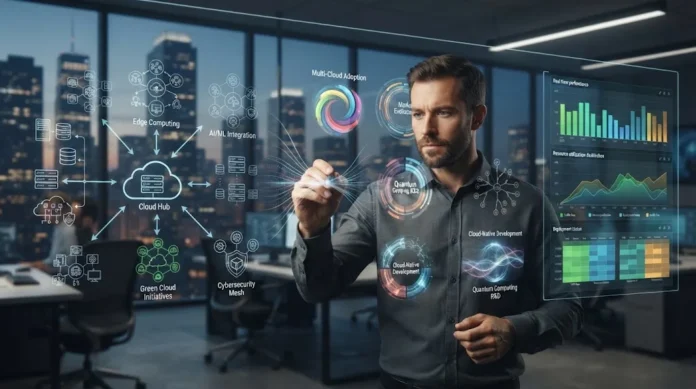

Cloud computing in 2026 is moving beyond the simple idea of renting servers and storage over the internet. Artificial intelligence, platform engineering, hybrid infrastructure, cloud security, FinOps, automation, and sustainability are changing how companies design and operate cloud environments. Businesses increasingly expect cloud platforms to support both traditional applications and demanding AI workloads.
The most important cloud computing trends in 2026 are therefore connected rather than isolated. AI increases infrastructure and energy demands, which strengthens the need for cost optimization, security, automation, and efficient hardware. Understanding these shifts can help cloud engineers, developers, IT leaders, and businesses make better decisions about architecture, skills, investment, and future cloud strategy.
Why Cloud Computing Is Changing Faster in 2026
Cloud environments have become significantly more complex than the virtual-machine-focused platforms many organizations originally adopted. Modern infrastructure can include Kubernetes, serverless functions, managed databases, data platforms, AI models, APIs, and services distributed across public and private environments. This complexity is pushing organizations toward more standardized operating models and stronger automation.
Cloud-native development is also becoming more mainstream. CNCF reported in 2026 that nearly 20 million developers are using cloud-native technologies, while standardized DevOps and platform environments are increasingly common among backend developers. This suggests cloud-native practices are moving from specialized infrastructure teams into everyday software development.
At the same time, cloud decisions are becoming business decisions rather than purely technical ones. Organizations now consider cost efficiency, security, governance, energy consumption, and developer productivity when evaluating infrastructure. The result is a cloud market where architecture must balance speed and innovation with financial, operational, and regulatory realities.
AI Infrastructure Is Becoming a Core Cloud Priority
Generative and agentic AI workloads are creating new infrastructure requirements across cloud platforms. Training and running advanced models can demand GPUs, high-performance networking, large storage systems, and specialized data pipelines. Cloud providers are therefore investing heavily in infrastructure capable of supporting AI workloads at increasingly large scale.
Organizations are discovering that moving AI prototypes into production requires more than simply adding a model to an existing application. Google Cloud’s 2026 infrastructure research found that many organizations expect infrastructure upgrades to support production-grade autonomous systems, highlighting how AI is reshaping compute, networking, governance, and operations.
This trend means cloud engineers will increasingly work with GPU scheduling, model serving, vector databases, AI pipelines, and workload optimization. AI infrastructure will not replace traditional cloud computing, but it will become another major workload category. Teams that understand both conventional cloud architecture and AI operations will become increasingly valuable.
Hybrid and Multicloud Architectures Are Growing
Businesses are continuing to combine public cloud, private infrastructure, and multiple providers rather than moving every workload into one environment. Hybrid architectures can help organizations keep certain data or applications under tighter control while still using public cloud services for scale, analytics, AI, or customer-facing workloads.
CNCF’s 2026 cloud-native research describes hybrid cloud as a dominant deployment model, while Google Cloud’s infrastructure report found that more than half of surveyed organizations were using hybrid multicloud architectures. These findings show that mixed environments are becoming a normal operating model rather than an exception.
The challenge is operational consistency. Teams need unified identity, networking, observability, security, and deployment practices across environments that may behave differently. Infrastructure as code, Kubernetes, GitOps, centralized monitoring, and policy automation can help reduce complexity while still allowing organizations to use the strengths of different platforms.
Platform Engineering Is Becoming More Important
Cloud infrastructure has become too complicated for every developer to master independently. Platform engineering addresses this problem by creating internal developer platforms that provide standardized environments, reusable infrastructure, self-service deployment, and approved development paths. Developers can use these capabilities without understanding every infrastructure detail underneath them.
Internal developer platforms can reduce cognitive load by turning complex cloud processes into easier workflows. Instead of manually configuring networking, monitoring, security, and deployment pipelines for every application, platform teams create reusable “golden paths.” CNCF discussions in 2026 also show platform engineering evolving to support AI-native workloads and more complex infrastructure requirements.
This shift can improve developer experience while strengthening governance. Teams move faster because infrastructure is already standardized, while security and operations teams gain more consistent environments. Platform engineering is likely to become especially valuable in organizations running Kubernetes, microservices, AI applications, and large numbers of development teams.
FinOps Is Moving Closer to Engineering
Cloud cost management is no longer something finance teams can handle only after monthly invoices arrive. Engineers increasingly need visibility into how architectural choices affect spending. FinOps brings technical, financial, and business teams together so organizations can understand cloud consumption and connect infrastructure costs with business value.
AI workloads are making this more important because GPUs, data processing, and large-scale model serving can create significant infrastructure expenses. Organizations are therefore paying closer attention to rightsizing, commitment discounts, idle resources, unit economics, and workload scheduling. Cost optimization is becoming part of architecture design rather than an occasional cleanup project.
AWS’s 2026 cost-efficiency research, based on tens of thousands of opted-in customers, emphasizes that the most efficient environments combine multiple optimization practices rather than relying on a single discount strategy. That reinforces a broader shift toward continuous cloud financial management and operational accountability.
Cloud Security Is Becoming More Unified
Cloud security is shifting from collections of separate tools toward integrated platforms that connect infrastructure posture, workloads, identities, data, applications, and runtime activity. Organizations need this broader visibility because modern cloud systems contain many interconnected components, making it difficult to evaluate risk by looking at each resource independently.
Cloud security posture management is also evolving. Microsoft describes modern CSPM as moving beyond basic configuration checks toward continuous, contextual risk management inside broader cloud-native application protection platforms. These systems increasingly combine posture information with identity, workload, runtime, and threat signals to prioritize the risks that matter most.
AI creates another security layer because models, pipelines, agents, permissions, and connected data sources introduce new attack surfaces. Security teams therefore need controls that cover both traditional cloud infrastructure and AI workloads. Unified code-to-cloud security, runtime monitoring, automated remediation, and AI security posture management are likely to remain important themes throughout 2026.
Serverless and Event-Driven Computing Keep Expanding
Serverless computing remains attractive because developers can run applications without managing every underlying server. Functions, managed container platforms, event systems, and serverless databases allow teams to focus more on application logic while cloud providers handle much of the infrastructure provisioning and scaling.
Event-driven architecture fits naturally with this model. Applications can respond automatically when a file is uploaded, a payment occurs, a message enters a queue, or another system generates an event. This makes serverless useful for APIs, automation, background processing, data pipelines, integrations, and workloads with changing demand.
Serverless is not the ideal choice for every application. Long-running or highly predictable workloads may sometimes be cheaper or easier to control using containers or virtual machines. The broader trend is toward selecting different compute models for different workloads rather than expecting one infrastructure pattern to handle every application.
Edge Computing Is Extending the Cloud
Edge computing moves selected processing closer to users, devices, factories, stores, vehicles, or other locations where data is generated. Instead of sending every request to a distant cloud region, systems can process time-sensitive information closer to the source and synchronize important data with centralized cloud services.
This approach can reduce latency and support applications that cannot depend entirely on continuous internet connectivity. Manufacturing systems, retail environments, telecommunications, connected devices, video processing, and real-time analytics are common areas where edge architectures can provide practical advantages.
Cloud and edge computing are therefore becoming complementary rather than competing approaches. Central cloud platforms remain valuable for management, analytics, storage, and large-scale computing, while edge infrastructure handles local processing. Organizations will increasingly need tools that manage applications, updates, security, and monitoring consistently across both locations.
Sovereign Cloud and Data Control Are Gaining Attention
Governments and regulated organizations increasingly care about where data is stored, who can access infrastructure, and which legal jurisdictions apply to cloud services. This is strengthening interest in sovereign cloud models, regional cloud offerings, encryption controls, and architectures designed around strict data residency requirements.
Data sovereignty can influence provider selection, backup locations, identity management, and application architecture. Organizations may need to keep certain datasets within approved geographic boundaries while still using global cloud services for less sensitive workloads. This creates additional planning requirements for multinational companies and highly regulated industries.
The trend does not mean organizations will abandon global public clouds. Instead, cloud strategies are becoming more selective. Businesses may combine global services with regional or private infrastructure depending on the sensitivity of each workload, reinforcing the broader movement toward hybrid and distributed cloud architectures.
Sustainability and Energy Efficiency Matter More
Cloud infrastructure consumes substantial electricity and water, and growing AI workloads are increasing attention on data-center efficiency. Cloud providers are investing in new cooling systems, power technologies, hardware optimization, and renewable or lower-carbon energy sources as infrastructure expands to support more demanding workloads.
Customers are also beginning to consider efficiency when making infrastructure decisions. Google Cloud reported in its 2026 infrastructure study that energy consumption influences hardware selection for many technology leaders. This connects sustainability directly with architecture, especially for organizations operating large AI or compute-intensive workloads.
Efficiency can align with financial goals because infrastructure that uses fewer resources often costs less to operate. Rightsizing workloads, choosing efficient processors, scheduling computing intelligently, and reducing unnecessary data movement can improve both sustainability and cloud economics. Energy-aware infrastructure decisions will likely become increasingly normal rather than remaining a separate environmental initiative.
How Businesses Should Prepare for Cloud Trends in 2026
Organizations should avoid reacting to every new cloud trend independently. Start by identifying business requirements, application workloads, security risks, and internal skills. AI, multicloud, Kubernetes, serverless, and edge computing can all provide value, but only when they solve a specific operational or customer problem.
Provider selection should also reflect these changing priorities. When deciding how to choose a cloud provider, compare AI infrastructure, regional coverage, security, automation, managed services, pricing, sustainability capabilities, and hybrid-cloud support rather than looking only at basic virtual-machine costs.
Finally, invest in skills and automation. Platform engineering, FinOps, cloud security, infrastructure as code, Kubernetes, AI operations, and observability are becoming increasingly connected disciplines. Organizations that standardize infrastructure and improve developer experience will be better positioned to adopt new cloud technologies without allowing complexity, security risk, or spending to grow uncontrollably.
Conclusion
Cloud computing trends in 2026 are being shaped heavily by AI, hybrid architectures, platform engineering, FinOps, integrated security, serverless computing, edge infrastructure, data sovereignty, and sustainability. These trends reflect a broader shift from simply moving applications to the cloud toward operating increasingly intelligent and distributed digital infrastructure.
AI may be the most visible trend, but it also increases the importance of every other area. Expensive compute strengthens the need for FinOps, complex AI platforms increase security requirements, and growing infrastructure demand makes energy efficiency more important. Modern cloud strategy therefore requires technical, financial, security, and operational thinking at the same time.
Businesses do not need to adopt every trend immediately. The strongest approach is to build solid cloud fundamentals, automate repeatable work, monitor costs and security, and select technologies based on real requirements. Organizations that keep infrastructure flexible and well governed will be better prepared as cloud computing continues evolving beyond 2026.
FAQs
What is the biggest cloud computing trend in 2026?
AI infrastructure is one of the biggest trends because organizations need GPUs, specialized networking, model-serving platforms, and stronger governance to move generative and agentic AI workloads into production.
Is hybrid cloud still growing in 2026?
Yes. Many organizations combine public cloud, private infrastructure, and multiple providers. Hybrid models help businesses balance flexibility, data control, existing systems, compliance requirements, and access to modern cloud services.
Why is FinOps important in 2026?
Cloud and AI infrastructure can become expensive quickly. FinOps helps engineering, finance, and business teams track consumption, reduce waste, forecast spending, and connect cloud costs with measurable business value.
Is Kubernetes still important for cloud computing?
Yes. Kubernetes remains important for cloud-native applications and portable container platforms, while platform engineering increasingly hides some of its complexity behind standardized developer workflows and self-service infrastructure.
How will AI change cloud computing?
AI is increasing demand for specialized compute, storage, networking, security, governance, and energy-efficient infrastructure. It is also encouraging cloud platforms to provide more managed services for model development, deployment, and operations.