
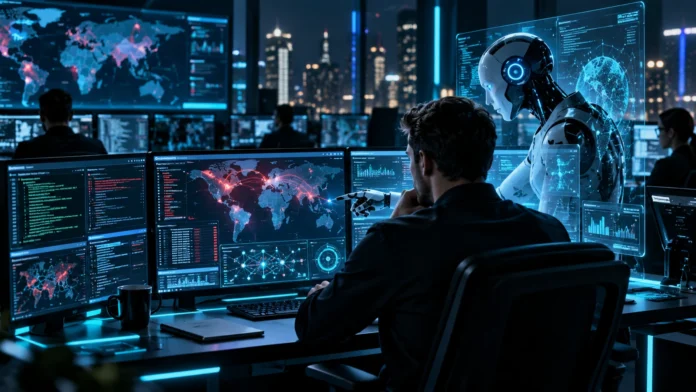

Artificial intelligence is changing cybersecurity quickly, raising an important question for students, analysts, and experienced professionals: will AI take over cyber security jobs? AI can already analyze large amounts of security data, detect suspicious behavior, summarize alerts, automate investigations, and help security teams respond faster. However, replacing cybersecurity professionals completely is a very different challenge from automating individual tasks.
The more realistic future is one where AI changes cybersecurity jobs rather than eliminating the entire profession. Repetitive work will increasingly be automated, while professionals will spend more time investigating complex threats, validating AI-generated findings, making risk decisions, communicating with leadership, and designing security strategies. People who learn how to work effectively with AI are likely to remain highly relevant.
How AI Is Already Changing Cybersecurity
AI is already being used to analyze massive volumes of security information that would be difficult for humans to review manually. Security platforms can examine network traffic, endpoint activity, login behavior, email messages, and other signals for suspicious patterns. This allows analysts to identify potentially dangerous activity faster and focus attention on events that deserve deeper investigation.
Generative AI is also helping security professionals summarize alerts, write detection queries, explain suspicious behavior, and organize incident information. Instead of manually reviewing long logs and reports, analysts can use AI tools to speed up routine tasks. This can reduce repetitive work and allow experienced staff to concentrate on decisions that require deeper technical knowledge.
However, AI-generated results still need verification. Security environments are complex, and an unusual event is not automatically malicious. AI can misunderstand context, produce inaccurate explanations, or prioritize the wrong signal, which means human judgment remains essential when decisions could affect business systems, sensitive information, or incident response.
Will AI Completely Replace Cybersecurity Professionals?
AI is unlikely to completely replace cybersecurity professionals because security involves more than recognizing patterns in data. Analysts need to understand business context, attacker behavior, system architecture, organizational priorities, legal obligations, and operational consequences. Many of these decisions require judgment rather than simply identifying whether an event looks statistically unusual.
Cybersecurity also involves unpredictable adversaries. Attackers actively change tactics when defenses improve, making security different from highly repetitive work with fixed inputs and outputs. Human defenders must interpret new attack techniques, investigate unfamiliar behavior, and decide how to respond when established procedures do not perfectly match the situation.
AI will probably replace or reduce certain tasks rather than entire professions. Manual alert summarization, basic log review, repetitive reporting, simple vulnerability classification, and routine security checks can increasingly be automated. Cybersecurity professionals who move toward investigation, engineering, strategy, architecture, threat hunting, and AI oversight will be harder to replace.
Which Cybersecurity Tasks Are Most Likely to Be Automated?
Tier-one security operations tasks are among the most obvious candidates for increased automation. AI can help review alerts, compare events against known indicators, collect related information, and create preliminary summaries. This may reduce the amount of time analysts spend manually gathering context before deciding whether an incident needs further investigation.
Vulnerability management can also benefit significantly from automation. Organizations often discover thousands of possible security weaknesses, making manual prioritization difficult. AI can assist by grouping similar findings, identifying affected assets, estimating business relevance, and helping teams understand which cybersecurity vulnerabilities may deserve faster remediation.
Reporting and documentation are additional areas where automation can save time. Security professionals regularly prepare incident summaries, executive reports, policy drafts, compliance evidence, and technical documentation. AI can create useful starting points, but humans still need to confirm accuracy, remove misleading statements, and make sure recommendations match the organization’s actual environment.
Cybersecurity Jobs Most Likely to Change
Security Operations Center analysts may experience some of the biggest changes because their work often includes high volumes of alerts and repetitive investigations. AI can handle basic enrichment and triage, which means analysts may spend less time processing obvious false positives and more time investigating unusual or higher-risk cases.
Vulnerability analysts may also rely increasingly on AI-assisted prioritization. Instead of manually reviewing long lists of findings, they may focus on understanding whether important systems are genuinely exposed and coordinating remediation. Technical knowledge will still matter because severity scores alone do not explain how a vulnerability affects a specific business environment.
Governance, risk, and compliance roles will change as well. AI can help compare policies, summarize requirements, organize evidence, and draft documents, but professionals still need to interpret regulations and understand organizational risk. Communication with executives, auditors, customers, and technical teams remains a human-centered responsibility that cannot be reduced to automated text generation.
Cybersecurity Roles That Are Harder for AI to Replace
Security architecture requires professionals to understand how systems, applications, networks, cloud environments, identities, and business processes interact. Designing secure environments involves tradeoffs involving cost, usability, performance, and operational requirements. AI can suggest architecture patterns, but experienced humans are still needed to determine what actually makes sense for a particular organization.
Incident response is another area where human judgment remains extremely important. During a serious breach, responders may need to isolate systems, coordinate with leadership, preserve evidence, understand attacker behavior, and make decisions under pressure. Incorrect automated action could disrupt critical business operations, so major response decisions often require accountable human oversight.
Leadership and security strategy are similarly difficult to automate completely. Chief information security officers and senior security professionals must understand business goals, communicate risk, prioritize investments, build teams, and balance security against operational needs. AI can provide analysis, but responsibility for organizational decisions ultimately remains with people.
AI May Create New Cybersecurity Jobs
As AI becomes more integrated into security products, organizations will need professionals who understand both cybersecurity and artificial intelligence. These roles may involve evaluating AI security tools, validating automated detections, testing model behavior, protecting AI systems, and designing governance processes for responsible AI use.
AI security itself is becoming an important area. Organizations using machine learning models and generative AI applications need protection against data leakage, prompt injection, insecure integrations, unauthorized access, and other emerging risks. Professionals who understand how AI systems work may find opportunities in securing these technologies rather than competing directly against them.
Security teams may also need specialists responsible for AI oversight and validation. Automated decisions can create risk when models produce false positives, incorrect recommendations, or unexplained conclusions. People who can test AI systems, measure their reliability, and identify where human approval remains necessary may become increasingly valuable.
Why Human Judgment Still Matters in Cybersecurity
Security decisions are rarely purely technical. A suspicious login from another country may indicate account compromise, or it could simply be an employee traveling for work. AI may recognize the unusual pattern, but understanding the surrounding context is often necessary before deciding whether the account should be disabled or investigated further.
The consequences of incorrect decisions can also be significant. Automatically blocking an important production system, deleting a legitimate file, or locking out critical users can cause operational damage. Human professionals help balance security urgency with business impact, particularly when available evidence is incomplete or contradictory.
Ethical and legal considerations add another layer of complexity. Security teams may handle employee monitoring, personal information, customer data, and sensitive investigations. Decisions about how information should be collected, analyzed, stored, and disclosed require accountability that organizations cannot simply assign to an automated system.
How Attackers Are Using AI Too
AI is not only helping defenders. Cybercriminals can use generative tools to improve phishing messages, automate research, generate convincing social engineering content, or scale certain parts of malicious campaigns. This creates an ongoing competition where both defenders and attackers use increasingly capable technology.
More believable phishing messages may make older warning signs less useful. Poor grammar and awkward wording are no longer reliable indicators when AI can generate polished emails quickly. Security awareness programs therefore need to focus more on verifying requests, checking links, protecting credentials, and recognizing unusual behavior rather than relying only on writing quality.
Attackers may also experiment with AI to help identify weaknesses or adapt malicious techniques. Defenders will need professionals who understand how these capabilities change threat behavior. As offensive tools become more sophisticated, skilled human analysts may become more important for interpreting unfamiliar attacks rather than less important.
Skills Cybersecurity Professionals Should Learn for the AI Era
Strong cybersecurity fundamentals remain the most important foundation. Professionals should understand networking, operating systems, identity security, cloud environments, endpoint protection, vulnerabilities, common attack techniques, and incident response. AI can provide explanations, but people need enough knowledge to recognize when those explanations are incomplete or wrong.
Learning how to work with AI tools is also becoming useful. Security professionals can practice writing clear prompts, validating generated results, using AI for log analysis, creating detection queries, summarizing incidents, and automating repetitive workflows. The goal should be using AI to increase productivity without blindly trusting every output.
Communication and critical thinking may become even more valuable as automation increases. Professionals who can explain technical risks to nontechnical stakeholders, challenge questionable AI conclusions, prioritize problems, and make informed decisions will remain important. Technical knowledge combined with business understanding creates a stronger career foundation than relying on one narrow tool.
Will Entry-Level Cybersecurity Jobs Disappear?
Entry-level cybersecurity roles are likely to change because many repetitive tasks traditionally assigned to junior analysts can now be partially automated. Basic alert triage, log summarization, and simple reporting may require fewer manual hours. This could raise expectations for people entering the industry and make practical skills more important during hiring.
However, organizations still need new professionals who can grow into experienced analysts, engineers, architects, and leaders. Cybersecurity cannot maintain a skilled workforce if every junior role disappears completely. Entry-level employees may simply start with more advanced responsibilities because AI handles some of the repetitive tasks previously used for training.
Students should therefore focus on hands-on ability rather than memorizing definitions alone. Building labs, learning networking, practicing cloud security, analyzing alerts, understanding common vulnerabilities, and completing realistic incident exercises can make candidates more valuable. Knowing how to use AI responsibly can provide an additional advantage instead of treating it as a competitor.
How Companies May Use AI and Humans Together
The most effective cybersecurity teams are likely to combine automated systems with human expertise. AI can monitor large amounts of activity continuously and identify events that deserve attention. Human analysts can then investigate unusual situations, validate evidence, and make decisions that account for technical and business context.
This combination can improve productivity significantly. Instead of spending hours manually gathering logs, analysts may receive a structured summary containing relevant devices, users, processes, and network activity. They can then spend more time answering the harder question: what actually happened, how serious is it, and what should the organization do next?
Automation may also allow smaller security teams to accomplish work that previously required more people. That does not necessarily mean every organization will reduce cybersecurity staff. Some may use the additional capacity to improve threat hunting, vulnerability management, cloud security, governance, and other areas that were previously under-resourced.
How to Future-Proof a Cybersecurity Career
Avoid building your entire career around repetitive tasks that technology can easily automate. Learn why security controls work, how attackers bypass them, and how systems connect together. Deeper understanding makes it easier to adapt when specific products, platforms, or automated tools change.
Develop experience across both technical and human aspects of security. Threat detection, cloud security, incident response, identity management, security engineering, risk management, and architecture all provide opportunities to solve problems that require context. Choosing one area for deeper specialization can also make your expertise more valuable.
Most importantly, treat AI as a tool to learn rather than something to avoid. Professionals who know how to use automation while recognizing its limitations can work faster and make better decisions. The strongest career strategy is becoming the person who knows when AI is useful, when it is wrong, and when human judgment must take control.
Should You Still Start a Cybersecurity Career?
Cybersecurity remains a worthwhile field for people who genuinely enjoy technology, investigation, problem-solving, and continuous learning. AI changes the tools professionals use, but organizations still need people responsible for protecting systems and making security decisions. The work is evolving rather than simply disappearing.
New professionals should expect the industry to demand more practical knowledge than before. Being able to explain basic concepts is useful, but employers increasingly value people who can investigate problems, use security tools, understand alerts, and communicate clearly. AI literacy can become another practical skill alongside networking, cloud, and security fundamentals.
Do not choose cybersecurity because you believe it is completely protected from automation. Almost every technology career will change as AI improves. A stronger reason is that cybersecurity requires continuous adaptation, adversarial thinking, technical understanding, and responsibility, all of which create opportunities for people willing to keep learning.
Conclusion
AI is unlikely to take over all cybersecurity jobs, but it will automate many repetitive tasks and change how security professionals work. Alert triage, reporting, basic analysis, and vulnerability prioritization are areas where automation can provide major efficiency gains. Professionals will increasingly be expected to use AI rather than work completely separately from it.
Human expertise remains important for complex investigation, security architecture, incident response, strategy, risk decisions, and communication. Attackers also continue adapting, which means cybersecurity requires people who can interpret new situations and make accountable decisions. AI can support those professionals, but automated outputs still need context and verification.
The best way to prepare is to strengthen cybersecurity fundamentals while learning how AI tools can improve productivity. Professionals who combine technical knowledge, critical thinking, communication, and AI literacy will be better positioned for the changing job market. The future of cybersecurity is likely to involve humans and AI working together rather than one completely replacing the other.
FAQs
Will AI replace cybersecurity analysts?
AI may automate parts of an analyst’s work, especially routine alert triage and reporting. Analysts will still be needed for complex investigations, validation, threat analysis, decision-making, and situations requiring business context.
Which cybersecurity jobs are safest from AI?
Roles involving security architecture, incident leadership, strategy, advanced threat hunting, engineering, and risk decisions are harder to automate completely. AI will still assist these professionals rather than leaving their work unchanged.
Is cybersecurity still a good career with AI?
Yes, but the required skills are evolving. People entering cybersecurity should develop strong technical fundamentals, practical experience, critical thinking, communication abilities, and an understanding of how to use AI security tools responsibly.
Can AI detect cyber attacks better than humans?
AI can analyze huge amounts of data quickly and identify suspicious patterns, but it can also generate false positives or misunderstand context. Effective detection often combines automated analysis with experienced human investigation.
What should cybersecurity students learn about AI?
Students should learn AI-assisted analysis, automation, prompt skills, output validation, and AI security risks alongside networking, operating systems, cloud security, vulnerabilities, identity, and incident response fundamentals.