
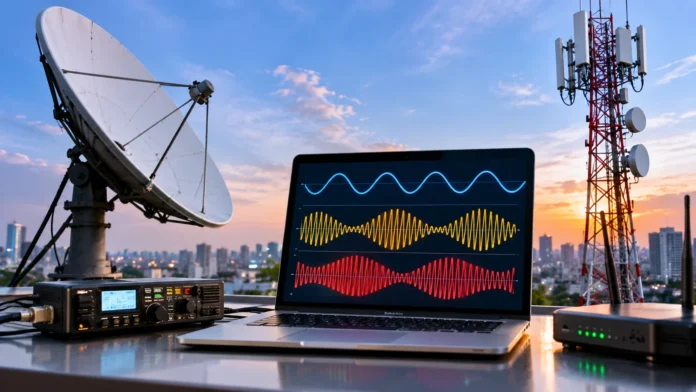

Modulation is an essential process in modern communication systems because it allows information to travel through electrical signals, radio waves, and other transmission channels. Without modulation, technologies such as radio broadcasting, wireless internet, and mobile communication would be much more difficult to implement efficiently. Understanding modulation meaning helps explain how signals carry information between devices and across networks.
Every time you make a phone call, listen to the radio, or connect to Wi-Fi, modulation plays an important role. It transforms information into signal variations that can travel through a suitable communication medium. These variations allow receiving equipment to recognize and recover the original message.
What Is Modulation in Communication?
Modulation is the process of changing one or more properties of a carrier signal according to the information being transmitted. The changed properties may include amplitude, frequency, or phase, depending on the communication technique. These controlled variations allow information to travel through a physical medium. Modulation is widely used in telecommunications, broadcasting, wireless networking, and digital communication systems.
A carrier is typically a periodic signal that provides a suitable foundation for transmission. Information from voice, video, text, or digital devices determines how the carrier changes. The resulting waveform is called a modulated signal. This signal can then travel through a communication channel to equipment designed to interpret its variations.
The main purpose of modulation is to make information suitable for reliable and efficient transmission. Different channels operate best with particular signal frequencies, bandwidths, and power levels. Modulation helps communication systems adapt information to these technical requirements. It also allows multiple transmissions to share available spectrum through appropriate channel allocation and signal processing techniques.
How Does Modulation Work?
Modulation begins when a communication system receives information that needs to be transmitted. This information may come from a microphone, computer, camera, or another electronic device. The transmitter prepares the information and uses it to control specific characteristics of a carrier signal. The exact process depends on whether the system uses analog or digital modulation.
Consider a radio transmitter sending audio information to listeners. The audio signal influences a carrier waveform according to the selected modulation technique. The transmitter then sends the resulting radio-frequency signal through an antenna. A compatible receiver detects the transmission and processes it to recover the audio information.
Digital communication follows a similar principle but represents information using discrete symbols. A transmitter maps groups of bits to defined signal states before transmission. The receiver estimates which symbols were sent and reconstructs the corresponding data. This process allows computers, smartphones, and networking equipment to exchange information through different communication channels.
Main Components of a Modulation System
A modulation system generally includes an information source, transmitter, communication channel, and receiver. The information source produces the message that needs to travel between devices. This message may contain audio, images, measurements, or computer data. Each component contributes to delivering the information in a form that the receiving system can understand.
The transmitter prepares information for transmission and generates the required modulated waveform. Its components may include signal processors, carrier generators, modulators, amplifiers, and filtering circuits. The communication channel carries the waveform between the transmitter and receiver. Channels can include free space, copper cables, optical fibers, and other suitable media.
The receiver detects the incoming signal and attempts to recover the transmitted information. Depending on the system, it may perform filtering, synchronization, demodulation, and error correction. These operations help separate useful information from noise and interference. Accurate recovery depends on factors such as signal strength, channel conditions, and receiver design.
Why Is Modulation Necessary?
Modulation makes it possible to transmit information using signal frequencies suited to the available communication medium. Directly transmitting certain low-frequency information signals can be inefficient, particularly in radio systems. Moving information onto a suitable carrier supports practical antenna designs and effective transmission. This is one reason modulation is fundamental to wireless communication technology.
Another important reason is efficient use of the available frequency spectrum. Different services can operate in assigned frequency bands without necessarily interfering with one another. Radio stations, mobile networks, and wireless devices depend on coordinated spectrum use. Modulation techniques help these services transmit information within their allocated bandwidth and performance requirements.
Modulation also gives engineers flexibility when designing communication systems. Certain techniques prioritize resistance to noise, while others emphasize spectral efficiency or simpler receiver hardware. No single method is ideal for every application. Selecting an appropriate modulation scheme helps balance reliability, transmission speed, power consumption, and equipment complexity.
Types of Modulation Explained
Modulation techniques are commonly divided into analog and digital categories. Analog modulation varies carrier properties according to a continuously changing information signal. Digital modulation uses a defined set of signal states to represent digital symbols. Both approaches serve important purposes, although many modern communication networks rely heavily on digital techniques.
Analog modulation is traditionally associated with radio broadcasting and earlier communication systems. Common examples include amplitude modulation, frequency modulation, and phase modulation. Each technique changes a different carrier property to represent information. Their technical characteristics influence bandwidth requirements, noise sensitivity, and the complexity of transmitting and receiving equipment.
Digital modulation supports communication between computers, smartphones, satellites, and network devices. Important methods include amplitude shift keying, frequency shift keying, phase shift keying, and quadrature amplitude modulation. These techniques represent bits using controlled signal changes. More advanced modulation schemes can transmit multiple bits per symbol when channel conditions are suitable.
What Is Amplitude Modulation (AM)?
Amplitude modulation changes the strength, or amplitude, of a carrier signal according to the information being transmitted. In conventional AM broadcasting, the carrier frequency remains constant while its amplitude varies with the audio waveform. These variations carry the sound information through the transmission channel. A compatible radio receiver extracts the audio from the received signal.
AM became widely used because it provides a relatively straightforward method of radio transmission. Conventional AM signals can be demodulated using comparatively simple receiver circuits. They are commonly associated with medium-wave broadcasting and certain long-distance communication services. However, their performance depends on transmission frequency, environmental conditions, and interference levels.
One limitation of conventional amplitude modulation is its sensitivity to certain forms of electrical noise. Interference that changes signal amplitude may become audible in the recovered sound. Conventional AM also uses transmitter power to carry a component that does not directly contain changing message information. Despite these limitations, AM remains useful in several established communication applications.
What Is Frequency Modulation (FM)?
Frequency modulation represents information by changing the instantaneous frequency of a carrier signal. The carrier’s amplitude ideally remains constant while its frequency varies according to the message waveform. In FM radio broadcasting, these controlled frequency changes represent audio information. The receiving equipment detects the variations and reconstructs the original sound.
FM broadcasting is popular because it can provide good audio quality and resistance to many amplitude-related noise disturbances. Its constant-envelope signal also supports certain efficient amplification methods. These characteristics make it suitable for broadcasting and selected communication applications. However, performance still depends on signal strength, interference, receiver quality, and other conditions.
Frequency modulation generally requires different bandwidth considerations from conventional AM. The occupied bandwidth depends on the maximum frequency deviation and the information signal’s frequency range. Engineers must account for these factors when assigning communication channels. Proper system design helps deliver reliable reception while limiting interference with neighboring transmissions.
What Is Phase Modulation (PM)?
Phase modulation changes the phase of a carrier waveform according to an information signal. Phase describes the position of a waveform within its repeating cycle. By controlling this position, the transmitter can represent changes in the message. The receiver processes the resulting waveform to recover the original information.
Phase modulation is closely related to frequency modulation because both involve changes in a carrier’s instantaneous angle. However, the mathematical relationship between the message and the carrier differs. In phase modulation, phase deviation follows the modulating signal directly. In frequency modulation, instantaneous frequency deviation follows the modulating signal.
Phase-based techniques are important in modern communication systems because controlled phase variations can represent information efficiently. Digital methods such as phase shift keying use selected phase states to carry symbols. These approaches are common in wireless and satellite communication. Their performance depends on accurate synchronization and suitable signal processing at the receiver.
What Is Digital Modulation?
Digital modulation converts digital information into signal variations that can travel through a communication channel. Instead of representing a continuously changing message directly, it uses predefined symbols associated with groups of bits. Each symbol corresponds to a particular signal state. The receiver identifies these states and reconstructs the transmitted digital information.
A digital modulation system may represent bits through changes in amplitude, frequency, phase, or combinations of these properties. The number of available symbols influences how many bits can be represented by each symbol. More complex schemes can achieve higher data rates within a given symbol rate. However, they often require better signal quality.
Digital modulation is widely used because it works well with modern signal processing and error-control technologies. Computers can encode, transmit, detect, and reconstruct information using carefully designed algorithms. Additional techniques help manage noise, synchronization problems, and transmission errors. These capabilities make digital modulation fundamental to contemporary communication networks.
Common Digital Modulation Techniques
Amplitude shift keying, commonly called ASK, represents digital symbols by changing the amplitude of a carrier. A simple version may use two amplitude levels to represent binary values. Frequency shift keying, or FSK, instead uses different frequencies to identify symbols. Both techniques appear in selected wireless, identification, and data communication applications.
Phase shift keying, known as PSK, changes a carrier’s phase between defined states. Binary phase shift keying uses two phase states, while quadrature phase shift keying uses four. QPSK can represent two bits per symbol. These methods provide different balances between data transmission efficiency, receiver complexity, and resistance to channel disturbances.
Quadrature amplitude modulation, or QAM, combines changes in amplitude and phase to represent digital symbols. Common examples include 16-QAM, 64-QAM, and 256-QAM. Higher-order QAM can carry more bits per symbol but generally requires cleaner reception. Modern systems often select modulation formats dynamically based on available signal quality.
Analog Modulation vs. Digital Modulation
Analog and digital modulation differ primarily in how they represent information through signal changes. Analog methods typically follow continuously varying message waveforms. Digital techniques use discrete signal states associated with digital symbols. Both require suitable transmitters, communication channels, and receivers to recover information accurately.
Analog modulation remains useful in established broadcasting systems and specialized communication equipment. Its implementation may be straightforward for certain applications. Digital modulation, however, supports advanced coding, flexible data formats, and sophisticated error management. These capabilities are especially important for high-speed networks and modern electronic devices.
Neither category automatically provides perfect transmission in every environment. Analog systems may experience gradual degradation as interference increases, while digital systems can show sudden performance deterioration near reception thresholds. Actual results depend on system design and channel conditions. Engineers select technologies according to reliability, bandwidth, compatibility, and application needs.
How Modulation Carries Data Through Signals
Communication signals carry information through controlled changes in measurable waveform properties. A receiver must recognize these changes to determine what information was transmitted. In digital systems, each permitted waveform state represents a specific symbol. Mapping digital bits onto these symbols allows binary information to travel through physical communication channels.
For example, a transmitter using QPSK can represent four different symbols through distinct phase states. Each symbol corresponds to a particular pair of bits. The receiver estimates the transmitted phase and determines the most likely symbol. This process translates signal measurements back into usable digital information.
Real communication channels introduce challenges that make symbol detection more difficult. Noise, interference, attenuation, and reflections can alter the received waveform. Receivers use synchronization, filtering, equalization, and other processing techniques to improve detection. Error-correcting codes provide additional protection by helping recover data affected by transmission errors.
What Is Demodulation and Why Does It Matter?
Demodulation is the process of extracting information from a received modulated signal. It performs the complementary function to modulation within a communication system. After a signal travels through a channel, the receiver analyzes its relevant characteristics. The goal is to reconstruct the original message or determine the digital symbols that were transmitted.
In an AM radio receiver, demodulation recovers audio information from changes in carrier amplitude. An FM receiver processes frequency variations to recover the transmitted sound. Digital receivers estimate symbols from defined amplitude, frequency, or phase states. Each technique requires processing methods suited to the modulation format.
Successful demodulation depends on receiving a signal with sufficient quality and using compatible equipment. Weak signals, interference, or poor synchronization can reduce recovery accuracy. Modern receivers may include sophisticated algorithms to compensate for channel distortion. These technologies help maintain communication performance under changing environmental and network conditions.
Modulation in Radio and Television Broadcasting
Radio broadcasting is one of the most familiar applications of modulation technology. AM and FM systems use radio-frequency carriers to transmit audio information across geographic areas. Broadcasting stations operate within assigned frequency bands and follow technical requirements. Radio receivers select the desired transmission and demodulate it to produce sound.
Television broadcasting also relies on modulation to transmit information over communication channels. Modern digital television systems combine video compression, error correction, and digital modulation. These technologies allow receivers to reconstruct picture and sound information from transmitted signals. Specific modulation standards vary between countries, broadcasting systems, and transmission methods.
Broadcasting demonstrates why efficient spectrum management is important. Multiple stations must operate without creating unacceptable interference for neighboring services. Transmission power, channel spacing, antenna characteristics, and modulation format all influence performance. Coordinated engineering helps broadcasting networks serve audiences while making practical use of limited radio-frequency resources.
Modulation in Wi-Fi and Mobile Networks
Wi-Fi networks use sophisticated digital modulation techniques to transmit information between wireless devices. Modern Wi-Fi standards commonly use orthogonal frequency division multiplexing, or OFDM, with modulation formats such as QAM on individual subcarriers. This approach helps manage multipath propagation and supports efficient data transmission. Actual performance depends on device capabilities and radio conditions.
Mobile networks also depend on digital modulation to connect smartphones with cellular infrastructure. Technologies such as 4G LTE and 5G use advanced radio transmission methods and adaptive modulation. Network equipment can select suitable signal formats according to measured channel conditions. This helps balance connection reliability and available data throughput.
When wireless conditions are favorable, systems may use higher-order modulation to transmit more information per symbol. Under difficult conditions, more robust modulation can improve successful reception. This flexibility helps wireless networks adapt to movement, interference, and changing signal strength. Modulation is therefore a major factor in practical wireless communication performance.
Modulation in Fiber Optic Communication
Fiber optic systems transmit information using light traveling through optical fibers. The information is represented through controlled changes in optical signal properties. Depending on the technology, these changes may involve intensity, phase, polarization, or combinations of characteristics. Optical modulation helps support high-capacity communication across metropolitan, regional, and international networks.
Some fiber optic systems use intensity modulation with direct detection. In these arrangements, transmitted information is represented by changes in optical power. More advanced coherent optical systems can encode information through amplitude and phase relationships. These methods support efficient transmission over long distances and high-capacity links.
Optical communication introduces technical considerations that differ from traditional radio transmission. Engineers must account for fiber attenuation, dispersion, nonlinear effects, and receiver performance. Modulation format selection influences achievable data rates and transmission reach. Careful design helps fiber networks support reliable internet connectivity and large-scale data transport.
Factors That Affect Modulation Performance
Signal-to-noise ratio is an important factor in modulation performance. It compares the strength of useful signal information with unwanted noise. A higher ratio generally supports more accurate detection and may allow more complex modulation formats. Lower signal quality increases the likelihood of transmission errors, particularly with closely spaced digital symbols.
Available bandwidth also influences the choice of modulation technique. Every communication channel has practical limits on the frequencies it can accommodate. Engineers must consider occupied bandwidth, symbol rate, filtering, and interference requirements. Efficient modulation helps transmit useful information while respecting the technical limitations of the assigned channel.
Other important factors include transmission power, channel fading, receiver sensitivity, and hardware imperfections. Wireless signals may weaken or reflect from buildings and other objects. Electronic equipment can introduce distortion that affects symbol recognition. Communication systems use suitable modulation, coding, and signal processing techniques to reduce the impact of these challenges.
Advantages and Limitations of Modulation
One major advantage of modulation is its ability to make information suitable for transmission through different physical channels. It enables communication systems to use practical carrier frequencies and allocated spectrum. Modulation also supports different data rates and performance requirements. These capabilities make it essential to broadcasting, networking, and telecommunications.
Advanced modulation methods can improve spectral efficiency by representing more information within available channel resources. However, higher efficiency often introduces additional technical requirements. Complex signal formats may require stronger reception, accurate synchronization, and more sophisticated hardware. Engineers must balance achievable throughput with reliable operation under real conditions.
Modulation cannot eliminate every communication problem. Signal loss, interference, limited bandwidth, and equipment imperfections still affect transmission quality. Some techniques also increase processing requirements and power consumption. Choosing the appropriate method is therefore important for developing communication systems that meet practical performance, cost, and reliability targets.
The Future of Modulation Technology
Modulation technology continues to evolve as communication networks demand higher capacity and improved efficiency. Researchers and engineers are exploring more flexible waveform designs and advanced signal processing techniques. These developments aim to improve performance under difficult channel conditions. Future systems will continue balancing transmission speed, energy consumption, reliability, and spectrum availability.
Adaptive modulation is already important in modern wireless networks and is expected to remain valuable. Communication equipment can change modulation formats according to available signal quality and other operating conditions. This flexibility helps systems use resources more effectively. Improvements in hardware and software may support faster adaptation and more efficient operation.
Emerging communication applications also create new technical challenges. Connected industrial systems, satellite networks, and future wireless technologies require dependable data transmission across diverse environments. Modulation will remain a fundamental part of these systems. Continued innovation will focus on meeting practical demands without unnecessarily increasing equipment complexity or energy requirements.
Conclusion
Understanding modulation meaning provides a foundation for learning how communication systems transmit information. Modulation changes selected properties of a carrier signal so that data can travel through suitable channels. Techniques such as amplitude modulation, frequency modulation, and phase modulation support different applications. Digital methods extend these principles to modern computer and wireless networks.
Modulation and demodulation work together to move information between transmitters and receivers. Their performance depends on factors including bandwidth, signal quality, interference, and system design. Choosing an appropriate technique helps balance efficiency and reliability. These considerations explain why communication engineers use different modulation formats for different technologies.
From radio broadcasting to Wi-Fi, mobile networks, and optical fiber systems, modulation supports everyday digital communication. Its importance will continue as networks become more advanced and connected devices exchange increasing amounts of information. Understanding the basic principles makes it easier to appreciate how modern signals carry data efficiently.
Frequently Asked Questions
What is the simple meaning of modulation?
Modulation is the process of changing a carrier signal’s properties to represent information. These changes allow sound, video, and digital data to travel through communication channels and be recovered by compatible receivers.
What are the three main types of analog modulation?
The three main types are amplitude modulation (AM), frequency modulation (FM), and phase modulation (PM). They represent information by changing a carrier’s amplitude, frequency, or phase, respectively.
Why is modulation used in communication systems?
Modulation helps make information suitable for transmission through available channels. It supports practical carrier frequencies, efficient spectrum use, and communication methods designed for different bandwidth, reliability, and performance requirements.
What is the difference between modulation and demodulation?
Modulation changes a carrier signal to represent information before transmission. Demodulation analyzes the received signal to recover that information. Both processes are essential parts of many electronic communication systems.
What is an example of modulation in everyday life?
FM radio is a common example. A broadcasting station changes a carrier’s frequency according to audio information, and a compatible radio receiver detects those variations to reproduce the transmitted sound.




